Blog
Protected: Wing Chun’s Third Form: Darting Finger – Biu Gee
Jeet Kune Do Certification


Jeet Kune Do Certification
What is Jeet Kune Do? You could say that Bruce Lee created his style of fighting that is his interpretation of Wing Chun mixed with elements of fencing, and Western boxing.
I have over 25 years of experience in belt-less systems. As I embark into becoming a fitness trainer, I feel grateful to have a specialization I believe in.
“I’m not telling you it is going to be easy – I’m telling you it’s going to be worth it.”
Arthur L. Williams, Jr.
NASM’s Business Accelerator

1.9 CEUs for NASM
[restrict …]
Getting Started (April 20 2020)
Module Requirements
Review the SyllabusProceed to Module 1
Module 1: <strong>Core Concepts</strong>
Module 1 Requirements
Watch the Module 1 VideosRead Lessons 1-4Review the Margin CalculatorComplete the Core Concepts ActivityComplete the Quiz
Notes:
Video:
10 Keys for Fitness Business Success:
- Personal Responsibility: Take active responsibility.
- Have Courage, Practice Faith.
- Your Business Is Not Different.
- Follow The Dang Instructions.
- CVPMGP: Core Values, Purpose, Mission, Goals, and Projects.
- Value = Client Experience + Relationships + Results.
- Get Your Crap Together: Be organized.
- Margins Equals Profitability.
- Know Your Numbers: Make informed decisions
- Commit To Results, Not Activity.
Packaging and Pricing:
- Create predictable revenue: contracted subscription.
- Good margins for personal training: 60% is the absolute minimum.
- Semi-private and group training: should all be 75% or higher.
- Start small and create a waiting list to be able to do group classes.


The 7.5 Step Communication Process:
- Sales Mindset: You are selling solutions.
- Mindset On Value: Your price is a sign/perception of value for your specific market.
- The Sales Process:
- Its an education process.
- Selling is serving
- We are in the business of changing lives
- The Auto-Closer 7.5 Step Sales System

Reading: Lessons 1-4
6 Stages of Fitness Business Growth:
- Stage One: Just starting out
- Stage Two: Work full time in the fitness industry
- Stage Three: Start a business
- Stage Four: Expand a business
- Stage Five: Mature a business
- Stage Six: Achieving your goals and ready for the next challenge


Packaging and Pricing:
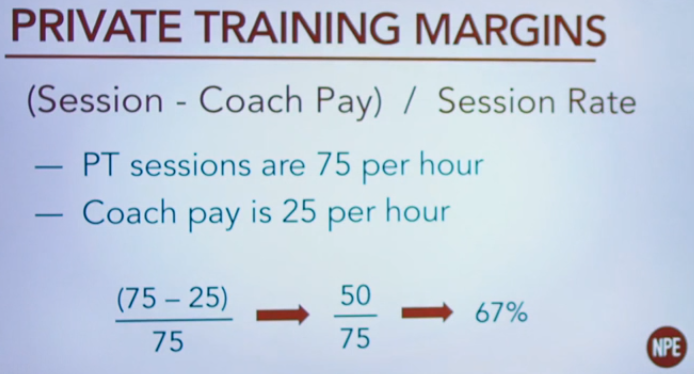
- (Session rate) – (Coach Pay) / Session Rate = Margin
- There are two variables: Coach Pay & Session Rate.
- Recommend 3, 6, and 12 month commitments for all your training services.
- Personal training margin minimum = 60%
Determining Your Prices
- Start w/ private training and work up to semi-private / group training.
- Start with private training, 12-month rate
- Add 5-10% for 6 month again for 3 month
- Semi-private is set no less than 60% of PT
- Group training is set between 15- 25% of Semi-private
Margin Calculator
Private Training
- Session Rate for 12 months: $75 (M = 62%) – $100 (M = 72%)
- 6 months: $78.75 – $82.50
- 3 months: $82.69 – $90.75
- Coach Pay: $28.47
| Program | Commitment | Sessions/Week | Monthly Investment |
| Totally Committed | 12 months | 4x/: 300 – 400 3x/: 225 – 300 2x/: 150 – 200 1x/: 75 – 100 | $1200 – $1600 $900 – $1200 $600 – $800 $300 – $400 |
| Committed | 6 months | 4x/: 315 – 330 3x/: 236 – 248 2x/: 158 – 165 1x/: 80 – 85 | $1260 – $1320 $944 – $992 $632 – $660 $320 – 340 |
| Sort of Committed | 3 months | 4x/: 331 – 363 3x/: 248 – 272 2x/: 165 – 182 1x/: 85 – 90 | $1324 – $1452 $992 – $1088 $660 – $728 $340 – $360 |
Module 2: <strong>Pre-Qualification</strong>
Module 2 Requirements
Watch the Module 2 VideoRead Lesson 5Complete the Step 1/2 ActivityComplete the Quiz
Notes
Video
Components of Pre-Qualification
- Can they afford your services? If they can’t afford you don’t waste each other’s time.
- Schedule the consultation. Once a day to start, and build to two.
- Set mindset for making a decision.
- Are they the decision maker? Try to get all decision makers involved in the sale process.
Pre-Qualification Script:
- Find out who they are and what their fitness goal is
- Are they currently exercising in any program?
- Tell them about your program.
- Give them a monthly investment range, and ask if it is in your budget. This is the first pre-qualifying question.
- If yes, schedule a consultation.
- Consults generally take 30 minutes, but could take 60 minutes. My next available appointment is this or this, which works best for you? Let them commit to a time.
- Let them know what to expect during the consult and make it clear that we will ask them to make a decision. We want to set them up to make a decision.
- Try to get all decision makers involved in the sale process, because they will miss the value proposition.


Reading: Lesson 5
- Pre-qualification: to determine if they’re the right fit for you, and if you’re the right fit for them before you schedule a consultation.
- The goal of pre-qualifying is to get qualified consultations scheduled.
- Should have a minimum of one to two hours a day blocked off for consultations.
The Pre-qualification Script
“Hey, this is Sean from XYZ Fitness returning your call regarding our personal training program. Have I reached you at a good time? Great! First, I’d love it if you could tell me a little bit about yourself and your fitness goals. Fantastic! Are you exercising or following any type of fitness program right now? Great! I appreciate you sharing that with me. I’d love to give you a little bit more information about how we work with our clients.
Currently, we offer complete 12-week programs in which we cover everything you need to know to get the best results possible from your fitness program. This means we spend a lot of time working with our clients on both the nutrition and the exercise components that are required for achieving serious results. We have clients who come in just for program design and then follow through with their programs on their own, either at home or in the gym.
We also have clients who meet with us anywhere from three to four times per week, depending upon their goals, motivation and budget. But all our programs generally require a 12-week initial commitment. The investment runs anywhere from 400 to 800 per month, depending upon which option you choose and what’s best for you. Is that in your budget?”
Okay, great! Well, the next step then is to schedule your consultation. Consultations generally take 30 to 45 minutes, and my next available appointments are Monday at 4:00pm or Tuesday at 5:00pm. Which works best for you? Great! During our consultation, I’m going to ask you some more questions. We’re going to review your goals in more detail,
and then, if we have a good fit, I’m going present our different program options to you.
If you like what we offer, I’ll ask you to make a decision about committing to your goals and to one of our programs. You can answer either yes or no and either answer is okay. Is that all right with you? Great! Before we go, I just want to share with you that when many of our current clients were deciding on working with us, they preferred to review the information with their spouse or family member before committing to a program.
Frankly, Jim, we encourage that because having a good support system at home is important to making a lifetime commitment to your health fitness goals. May I ask, if you do like our programs and we do have a good fit, is there anyone else involved in the decision of you joining our programs? No? Okay, great. Well, then I look forward to speaking with you on Monday at 4:00pm.”
Script Breakdown
Module-2_Auto-Closer-Lesson-5“Tell me a little bit about yourself and your fitness goals” and “Are you exercising or follow any type of fitness program right now?”
We want to get the general idea of what our prospects are looking for.
Module 3: <strong>Rapport Building and Discovery</strong>
Module 3 Requirements
Watch the Module 3 VideoRead Lesson 6Review the New Client Consultation FormComplete the Step 1-2 ActivityComplete the Quiz
Notes:
Video:
- Enter the consultation
- Step 1: Building rapport
- mirroring & rhythm
- Step 2: Probing & discovery questions
- emotional drivers
- open-ended questions
- emotional drivers
- New client consult form
- 1st 3 questions are key
- “I’m not telling you it’s going to be easy. I’m telling you it’s going to be worth it”


Reading: Lesson 6
- Rapport building
- building trust
- Probing & Discovery Questions
- understand their goals
- understand their emotional drivers
- commitment
- “On a scale of 1 – 10, how committed are you to achieving your goals?”
- we’re not going to move on until we get to at least an 8 out of 10.
New Client Consultation Form
Auto-Closer_New-Client-Consultation-FormModule 4: <strong>Identifying Needs and Building the Problem</strong>
Module 4 Requirements
Watch the Module 4 VideoRead Lesson 7Complete the Step 3-4 ActivityComplete the Quiz
Notes:
Video:
- Step 3: Identify Needs
- Step 4: Building the Problem


Reading: Lesson 7
- Step 3: Identifying Needs
- Restate the challenge or their struggle
- Hold up the mirror (get them to acknowledge the restate)
- Ask, “Is that right?”
- Step 4: Problem-building


Identifing Needs & Problem-Building Scripts


Module 5: <strong>Solution Presentation and Closing the Sale</strong>
Module 5 Requirements
Watch the Module 5 VideoRead Lesson 8Review the Blank AUTO-CLOSER(r) PresentationComplete the Step 5-6 ActivityComplete the Quiz
Notes:
Video:
- Step 5: Presenting the solution
- good to have visuals to help learning retention
- Step 6: Closing the sale


Reading: Lesson 8
Module-5_Auto-Closer-Lesson-8Module 6: <strong>Objection Handling</strong>
Module 6 Requirements
Watch the Module 6 VideoRead Lesson 9Review the AUTO-CLOSER(r) Example VideoComplete the Step 7 ActivityComplete the Quiz
Notes:
Video:


Reading: Lesson 9:
Module-6_Auto-Closer-Lesson-9Module 7: <strong>Post-Consultation Actions</strong>
Module 7 Requirements
Watch the Module 7 VideoRead Lesson 10Complete the Post-Consult ActivityComplete the Quiz
Notes:
Video:


Reading: Lesson 10


Final Exam
Module Requirements
Complete the Final ExamComplete the Course Survey
<strong>Bonus Lessons</strong>
Module Requirements
Watch the Bonus VideosRead Bonus Lessons 1-4
Notes:
Video: Telling Your Story


Video: Defining Your Ideal Prospective Client


Video: 25 Ways To Get A Client


Video: Raising The Rates


Reading: Bonus Lesson
Module-9_Auto-Closer-Lessons-11-14-BonusBonus Content From NPE
Get a bonus 30-minute strategy session with a NPE Success Coach
- Overcome your biggest challenges
- Get clarity with a path forward to achieve your goals
- Come away with new insights you can apply now
Plus, get a copy of our “Fitness Business Start-Up Guide.” This step-by-step guide includes bonus tools and templates you can use to turn your passion for fitness into a highly profitable business.
[/restrict]
Passing the NASM CPT Exam


I am most happy to say that I just passed my exam today! Because of the COVD-19 outbreak, NASM chose to use ProctorU as an option to take the test online. The experience was a little buggy, but hey I passed and that’s what counts.
I first conceived the goal of getting a CPT back in August 18, 2018. Thanks to being laid off late last year due to a company reorganization, I used a portion of my continuing education from my severance package to pay for this endeavor, which I began studying in the middle of January this year.
NASM CPT: GUIDED STUDY COURSE – MODULE 10
Final
Complete the Course Exam with a score of 80% or higherPractice taking Practice Exam 1 and 2Review the Personal Training Resources moduleStudy the NASM-CPT Study Guide moduleComplete the End-of-Course requirements

Domain 4
- Chapter 6 is in module 2
- Chapters 7-9 is in module 3
- Chapters 10-12 is in module 4
- Chapter 13 is in module 1
Domain 3
- Chapters 14 & 15: module 6
- Appendix E: module 9
Domain 2
- Chapter 6 is in module 2
- Appendix E: module 9
Acute Variables
| Phase | Sets | Reps | % of 1RM | Rest |
| Muscular & Stabilization | 1-3 | 12-20 | 50-70 | 0-90 secs |
| Hypertrophy | 3-5 | 6-12 | 75-85 | 0-60 secs |
| Maximal | 4-6 | 1-5 | 85-100 | 3-5 mins |
| Power | 3-6 | 1-10 | 30-45 | 3-5 mins |
Knees move inwards
- Overactive: The thighs (both inner and outer).
- Biceps femoris (short head)
- Vastus lateralis (the largest and most powerful part of the quadriceps femoris, a muscle in the thigh…together with other muscles of the quadriceps group, it serves to extend the knee joint, moving the lower leg forward, pg 626).
- TFL (tensor fascia latae, a tiny muscle, inferior to the iliotibial band. This band, also called the IT band, pg 631)
- Adductor complex (a group of muscles that primarily function to adduct the femur at the hip joint…they are all located somewhere along the medial side of the thigh…they all originate in different places at the front of the pelvis, adductor longus, adductor magnus, adductor brevis, gracilis, & pectineus, pg 628)
- Underactive:
- Vastus medialis oblique (VMO) (one of the four quadriceps muscles, located on the front of your thigh, above your kneecap, pg 627)
- Gluteus medius/maximus
- Stretching:
- SMR: Adductors
- SMR: TFL / IT band
- Static: supine biceps femoris stretch
- Static: stand TFL stretch
- Exercises:
- Tube walking (side to side)
Cardio-respiratory (chapter 6 & 8)
Intensity
- Peak V02 Method: the maximal amount of oxygen that an individual can use during intense exercise. Often impractical for personal trainers.
- V02 Reserve Method: the preferred method. V02R requires the calculation of V02max.
- Peak Metabolic Equivalent (MET): used to describe the energy cost of physical activity as multiples of resting metabolic rate.
- Peak maximal Heart Rate (MHR): the most commonly used formula for estimating HRmax: [220 – age] or [208 – (0.7 x age).
- HR Reserve Method (HRR, Karvonen): the difference between a client’s predicted maximal heart rate and their resting heart rate.
- Ratings of Perceived Exertion Method: the client’s subjective ratin on the perceived difficulty of exercise.
- Talk Test Method: if a client is unable to carry a simple conversation during exercise, then they are exercising too hard.
Category of Cardiovascular Fitness
| Category | Zone | % | Formula |
| Poor | 1 | 65-75 | HRmax X .65 |
| Fair | 1 | 65-75 | HRmax X .75 |
| Average | 2 | 76-85 | HRmax X .76 |
| Good | 2 | 76-85 | HRmax X .85 |
| Very Good | 3 | 86-95 | HRmax X .86 |
| Very Good | 3 | 86-95 | HRmax X .95 |


Nutrition


Adenosine Triphosphate
Energy storage and transfer unit within the cells of the body. Three metabolic pathways in which cells can generate ATP:
- The ATP-PC system: 10-15 seconds.
- The glycolytic system (glycolysis): 30-50 seconds.
- The oxidative system (oxidative phosphorylation): Indefinite period of time.
- Aerobic glycolysis: The process is the the same as anaerobic except oxygen with pyruvic acid is converted into acetyl coenzyme A (acetyl CoA).
- The Krebs cycle: a key metabolic pathway that connects carbohydrate, fat, and protein metabolism. The reactions of the cycle are carried out by eight enzymes that completely oxidize acetate (a two carbon molecule), in the form of acetyl-CoA, into two molecules each of carbon dioxide and water.
- The electron transport chain (ETC)
Anatomic Locations
- Superior
- Inferior
- Proximal
- Distal: refers to a position away from the center of the body or point of reference.
- Anterior
- Posterior
- Medial
- Lateral
- Contralateral: refers to a position on the opposite side of the body.
- Ipsilateral: refers to a position on the same side of the body.
Functional Anatomy of Muscles
- Force: An influence applied by one object to another, which results in an acceleration or deceleration of the second object.
- Length-tension relationship: The resting length of a muscle and the tension the muscle can produce at this resting length.
- Force-couple: Muscle groups moving together to produce movement around a joint.
Effective Communication Skills
- Nonverbal & verbal
- Active listening
- Asking questions
- Closed-ended (directive)
- Open-ended (nondirective)
- Reflecting: conversational techniques that express the purported meaning of what was just heard…an opportunity to make sure that what a client says is accurately understood.
- Summarizing: a series of reflections.
- Using Affirmations: shows appreciation for clients and their strengths.
- Asking permission
Miscellaneous
- Autogenic inhibition relies on the nerve fibers from a stretched muscle to cause that muscle to relax, thus allowing for a greater stretch. Reciprocal inhibition involves an agonist and antagonist effect. In order for an agonist to contract and cause movement, the antagonist incurs a reflexive relaxation to allow the movement.
- Autogenic inhibition: The process by which neural impulses that sense tension are greater than the impulses that cause muscles to contract, providing an inhibitory effect to the muscle spindles.
- Reciprocal inhibition: The simultaneous contraction of one muscle and the relaxation of its antagonist to allow movement to take place.
- Golgi tendon organ: When excited, causes the muscle to relax to prevent injury. Prolonged stimulation provides an inhibitory action to muscle spindles. This neuromuscular phenomenon is called autogenic inhibition.