• Skip to primary navigation
  • Skip to main content
  • Skip to primary sidebar

ReGroove Fitness

by Wellness Coach Dan Ma

  • Somatic Performance
    • Martial Movement
    • Skill-Based Exercise
  • Wellness Program
  • About
  • Location
  • Testimonials

Blog

The Art of Fighting Without Fighting

August 4, 2023 by Dan Ma Leave a Comment

Bruce Lee in Enter the Dragon

Why Fighting is Necessary

I don’t condone violence, but I think the idea of fighting in the broader sense is healthy when responsible. I think it’s unrealistic and unhealthy to not stand up for your needs and wants. Here are some points that resonate with me:

  1. In order to evolve, sometimes people need an ego-check. The saying “I’m going to teach them a lesson” doesn’t have to be done with an a$$ whooping, though that can be gratifying, it can also be done with the right tone and word usage. Sometimes people need a swift kick to the ego-nuts to start to a change. When I say something blunt and honest and I’m able to get through, they may say “thanks, I needed that”. That’s what I am talking about here.
  2. Real value is only appreciated when you invest yourself. If you aren’t able to fight for what you care about, then it might be time to reevaluate your convictions. You need conviction and confidence to overcome obstacles in life, and when you truly want something, you should get it before it’s too late.
  3. Fight for your respect. In my early years I moved through life being invisible, and catering to people’s needs while neglecting my own. Living my life as a doormat did not favor my best outcome and it invited abusive relationships and violent encounters.

Fighting People VS Letting People Fight Themselves

When ever I used to try to help someone who doesn’t want any help, I usually end up in an argument that leads to zero change. No one feels heard or understood. In a way I end up fighting myself trying to fit a round peg into the wrong shape. Fighting against someone plus myself is a loosing battle. When you let others fight themselves, you are typically on the winning side, because they have little to push against. All that is needed is for your idea to slide past their guard. It is usually the punch that they are not expecting that knocks them out.

Stop Fighting Yourself

I noticed a couple years ago that I was stuck in many patterns of beating myself up while being stuck in the past or future.

  1. I’m a big fan of self-reflection, but being stuck in the past would keep me in an emotional trap of competition and judgement. I used to replay scenarios, so that I could insert how I could have done better. Later I realized that I became used to fantasizing about violence. Developing a violent mindset didn’t keep me more safe, in fact it invited more of the same. It was the same battle for self-respect, but I was beating myself up each time. The past can keep you from moving on. I like to resolve them and move on, but it’s hard to move on if you don’t resolve them, because they seem to have a way of lingering without you noticing that they are there.
  2. I think the future has pros and cons just like the past. The future can give you a place to project your dreams and creative desires, but it can also bring uncertainty, ambiguity, and risk. Anxiety can lead to fear. Scarcity mindset and things getting in the way of your goals can be confused with fear. Living life in anxiety and fear is certainly an ass-kicking experience. Having goals is a great thing, but I think being goal-oriented has some negative trappings to be aware about. Having a goal-orientation can bring comparison, competition, and judgment. These concepts are aggressive and can lead to a violent mindset. It also interferes with living in the present, because when you are chasing goals it is hard to be present with someone.

Living more in the present has allowed me to be more compassionate, vulnerable, and authentic. I don’t have to be burdened by holding onto useless things. If I invest into a process, I can be present and let the goals come to me. It becomes more about a healthy process of things rather than being goal-oriented.

I don’t want my paycheck to be my life, so being more present in my life has led to a healthier mindset. I’m not fighting who I am, because I am who I am in the moment. Not perceived notions of the past and future. When you live too much in the past you limit yourself. When you live too much in the future you can’t truly be.
Filed Under: Blog, Contemplation, Jeet Kune Do

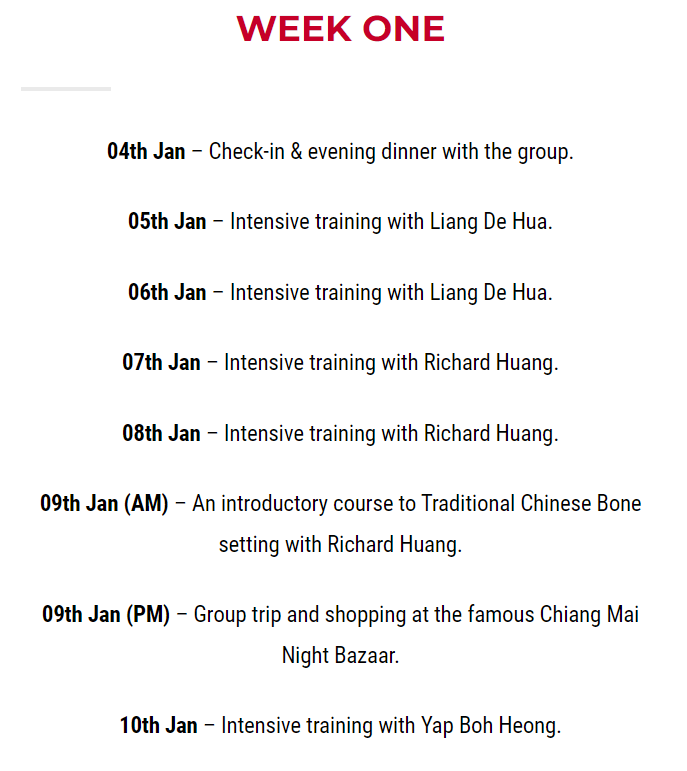
2023 Martial Camp in Chiang Mai Thailand

November 29, 2022 by Dan Ma Leave a Comment

I will be going this

Filed Under: Blog, Martial Arts

Bruce Lee’s Simplified Wing Chun or Jun Fan Kung Fu

July 28, 2022 by Dan Ma Leave a Comment

I read some where that Bruce Lee’s Jun Fan Kung Fu in the early days of Seattle (and perhaps also, many elements of Original JKD’s curriculum) is a simplified version of his Wing Chun journey that he mainly learned from Wong Shun-leung or perhaps his uncle Fook Yueng who is reported as his other kung fu master. Nevertheless, the purpose of this article is to explore the very patchy and various hearsay of the idea of Bruce Lee’s simplified Wing Chun. I have been studying JKD on and off for around twenty years and if I was to identify his so-called simplified Wing Chun I would include these:

  • The vertical fist (Wing Chun’s sun character fist)
  • The Straight-blast (or his modified expression of Wing Chun’s chain-punching)
  • Pak Da from reference point
  • Lap Da from reference point
  • The finger jab (or Wing Chun’s biu sau)
  • Trapping (or a portion of Wing Chun’s chi sao)
  • Bong Lap drills (pretty much the same Wing Chun drill except the punch is a backfist)
  • The Push Shuffle (a modified version of Wing Chun’s forward footwork)
  • The Straight Kick (Somewhat similar to Wing Chun’s front kick)
  • The Side Kick (Bruce Lee’s side kick is more explosive and telegraphic when compared to Wing Chun’s side kick)

Most of this curriculum can be found by Jerry Poteet’s foundational videos. What did I get right, what did I get wrong, and what did I forget to include? Please help me figure this out and comment below, thanks!

Filed Under: Jeet Kune Do, Wing Chun

How To Fix Lower Back Pain

June 13, 2022 by Dan Ma Leave a Comment

About 8% of the global population experience persistent or chronic back pain and it is increasing in the global population. I am writing this article because I have firsthand experience with chronic back pain. I want to share with you my journey in how I cured ten years of chronic back pain and condensed a decade of experience and knowledge into a three-month strategy. Please feel free to skip to the bottom to learn how I fixed my lower back pain.

How I Developed Chronic Lower Back Pain

My history with lower back pain started around 2009 or earlier. From gaming addiction, a web design degree, and falling into the marketing industry I have a long history of being in front of a computer. My back pain was a gradual progression.

The problem with gradual back pain is that it can be dismissed, and over a period of time it can become normalized”

After working for a company for six years, I was laid-off due to a reorganization a couple of months before the pandemic. I used my educational severance to get certified as a personal trainer specializing in corrective exercise. It taught me that physical patterns in life could affect your body. My specific pattern was too much time in front of a computer, which first came in the form of too much sitting. Later I learned that too much standing in front of a computer brought other problems.

Patterns and How They Affect Your Life

Sitting all the time created short and tight hip flexors, and long and weak my hip extensors (the glutes). This brought the classic condition for my hip complex to be tugged out of alignment. This gave me dull aches to shooting pain. In the beginning it was excruciatingly new, but overtime I got use to dealing with the pain. Standing too much in one place made my tensor fasciae latae too tight, and made it feel like my leg was being jammed into my hip socket. These are physical outcomes from physical patterns, but it took me a long time to understand the pain of non-physical patterns.

Mental and Emotional Patterns

Chronic back pain is a form of trauma and it can take a long time to develop without you being aware of the long-term effects. When you live in constant fear of acute pain, the mental and emotional patterns can become ingrained without you being aware of it. Does the following seem familiar?

  • Coming home mentally, emotionally, and spiritually drained after your commute home from work.
  • Coming home from work feeling grumpy and easily agitated.
  • Getting into fights with your significant others about the same things without any resolutions.
  • General feelings of being unappreciated and unsupported by your loved ones.
  • Feeling isolated and lonely.

These might not be your mental and emotional patterns, but I encourage you to explore what yours could be. It took me many years to see how my happy, outgoing, and adventurous personality gradually turned into being isolated and disgruntled. This slow personality change affected my relationships and eventually helped shape my heart-breaking divorce.

How to Address Negative Patterns

What are your daily to weekly patterns? For physical patterns, you should be asking what you do all day. Do you work in front of a computer? Do you commute? Are you a gamer? These are sitting patterns.

Pay attention to your mental and emotional patterns. Are they generally good or bad? Does your back pain have anything to do with them? Patterns in relationships can be hard to tackle, but I am willing to guess that your chronic back pain has some kind of impact on your relationships. It would be good for you and your relationships to identify how your back pain is shaping your mental and emotional well-being, so you can communicate that to the people who care about you. If talking is a challenge, then perhaps you could think about writing a letter. In either case of physical or non-physical patterns, it is usually a good idea to get outside help to move you along the path of recovery. Do not wait too long on this, and above all, be very forgiving to yourself and those in your life.

Foam Rolling and Static Stretching

One thing I know that helps for physical patterns is foam rolling and stretching. This helps break up soft tissue knots and helps keep them hydrated and more pliable. After foam rolling, you need to stretch and lengthen your soft tissue. For example, if you sit too much your hip flexors are probably too tight and short. Conversely, your hip extensors are too long and weak. For this pattern, you generally need to foam roll the areas that are too tight and short first, then you need to stretch and lengthen them. For the areas that are too long and weak, you generally need to exercise them to become stronger, so for the hip extensors you will probably need to do squats to strengthen your glutes. 

Foam rolling and stretching alone might not fix your issue. I learned this the hard way.”

I used to foam roll and stretch three times a day for about two years. One session could take up to one hour. It dominated my life and took time away from my family, which helped further isolate me. 

Compound Exercise and the Kinetic Chain

NASM’s OPT Model

I spent a lot of time foam rolling, stretching, and doing stability endurance exercises for many years without solving my chronic lower back pain. In hindsight, it seemed as though I was simply maintaining my pain on a week-to-week basis, which was far from satisfactory. From my experience, doing stability exercises was not enough. I also found that isolated exercises was not enough to fix my lower back.

The big turning point for me was when I started doing compound exercises for strength endurance.”

The kinetic chain is often talked about in physical therapy, because it views the body as a system of soft-tissue, joints, and segments that are all interrelated that forms a “chain”, which all works together to produce human movement. One compound exercise that had a significant impact on my path to full recovery is the single-arm squat to press. This exercise covers the chain from your feet all the way up your arm.

Any deficiencies in that kinetic chain will be addressed over time.”

The beauty of compound exercise with a focus on the kinetic chain is that the whole chain is strengthened, which is a more holistic approach than focusing on a specific area. Chasing specific areas can become a giant juggling act in where you are trying to address multiple muscle imbalances. Compound exercises also raises the heartbeat providing you with a cardiovascular challenge. Dropping weight can have an extreme amount of relief of stress on your body.

Steps to Fixing Chronic Back Pain

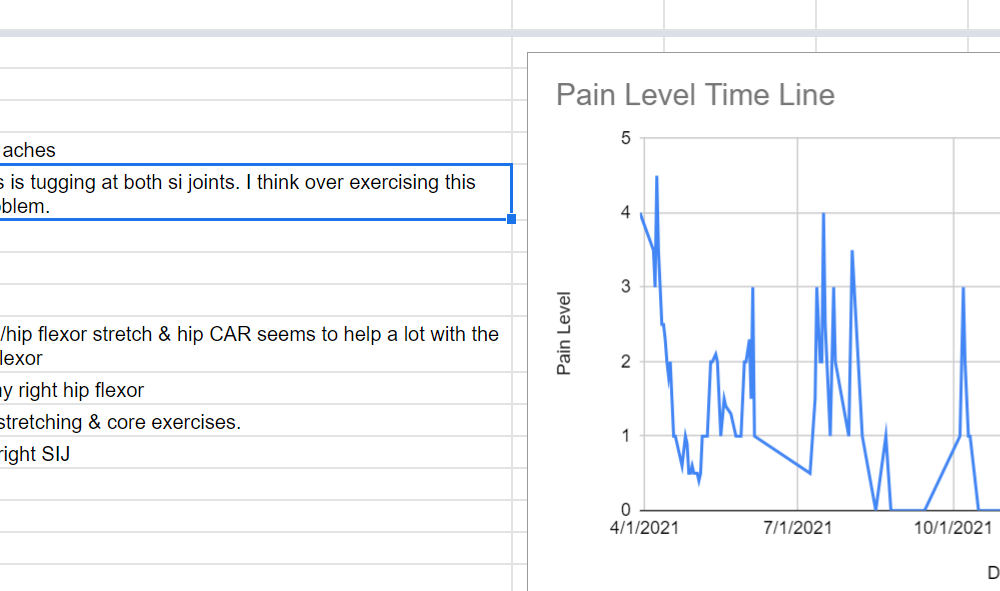
  1. Understand and educate yourself in what you do to your body on a day-to-day basis. I highly recommend that you track your pain. Google Sheets is great as you can access the file on your smartphone. Feel free to use my “pain rating” scale (see below), or come up with your own that fits your needs.
  2. Foam roll and stretch. This is an absolute must in my opinion. While it might hurt at first, it will get better. Foam rolling is a practice that informs you in what your body is telling you. If you foam roll an area and it hurts, your body is telling you it needs some work. After you foam roll you will need to stretch and lengthen those areas. There are plenty of resources on YouTube on how to foam roll and stretch. I recommend half a minute per stretch (at the bare minimum), but one minute will give you much better results. If you are in acute pain, I recommend two minutes per stretch.
  3. If you are not in acute pain, I recommend a month of stability endurance training with a focus on core exercise. Also, remember to do lots and lots of foam rolling and stretching (as if it is going out of style).
  4. After a month without any relapses, I would start to slowly introduce strength endurance training with a focus on compound exercise. This could look like doing one set per week and slowly increasing it on top of your stability endurance. As you progress, you can completely replace your stability endurance with strength endurance. If you go too fast and do too much, you will probably upset your body and go back into acute pain. I learned this the hard way, over, and over again. In my case, going slow would have been faster.
  5. After another a month or two of no relapses into acute pain, you will probably develop new goals for your fitness and health. Regaining your confidence to live your life without fear of acute pain is a huge accomplishment. Your quality of life goes way up along with your mental and emotional health. Realistically at this point, you should be able to maintain your process without having to worry about your back pain. Foam rolling & stretching should not have to dominate schedule, and you should be able to get out there and live an active life. I recommend that you don’t get stuck in a strength endurance pattern, and change it up every month. You can go back to stability endurance, progress up NASM’s OPT model, or cardio & core is always a great option. If you track your pain as I suggested in step 1, you will know how to fix yourself in the event you fall into a pain crisis.

Summary

  1. Month 1: Get out of back-jail and away from being in acute pain. Foam roll and stretch at least three times a week or more. When you start to feel better start to slowly introduce stability endurance training with a focus on core exercise. Start with one exercise a week after foam rolling and stretching, then slowly build up three times a week.
  2. Month 2: Still being out of back-jail, you should definitely start to introduce stability endurance training with a focus on core exercise. Slowly introduce a stability core exercise such as floor bridge, bird-dog, or planks. Start once a week, then build up to three times a week. Pay attention to what your body is telling you and know your limits. Don’t worry about keeping to a three month plan, take as long as your body needs. Here are the acute variables (reps & sets) for phase 1 stability endurance.
  3. Month 3: Continuing to be out of back-jail, begin to slowly introduce a compound strength endurance exercise like a single-arm squat to press. Be even more careful to slowly introduce this phase of exercise as you will be adding external weight to your body frame. Here are the acute variables for phase 2.

That’s it, take it slow and listen to your body. If you have a setback, go back to the beginning and get out from acute pain. Please comment below and share your experiences, and let me know what you are experiencing. Perhaps I can further help you. I’d love to hear from you.

Filed Under: Blog, Fitness & Health

Wing Chun Instructor Certification

September 27, 2021 by Dan Ma Leave a Comment

Today, after many hours of hard work and dedication, I was awarded the instructor certification by the Lightening Hand Academy of Wing Chun Kung Fu.

Filed Under: Certifications, Wing Chun

Wing Chun Coaching at LHA

August 24, 2021 by Dan Ma Leave a Comment

I have started coaching at Lightning Hand Academy

Filed Under: Wing Chun

« Previous Page
Next Page »

Primary Sidebar

  • Somatic Performance
  • Wellness Coaching
  • About
  • Blog
  • Contact

ReGroove Fitness | Somatic Personal Training in Portland, OR


Loading Comments...