• Skip to primary navigation
  • Skip to main content
  • Skip to primary sidebar

ReGroove Fitness

by Wellness Coach Dan Ma

  • Somatic Performance
    • Martial Movement
    • Skill-Based Exercise
  • Wellness Program
  • About
  • Location
  • Testimonials

Blog

The Versatility of Martial Arts Practice Using NASM’s OPT Model

January 22, 2020 by danma Leave a Comment

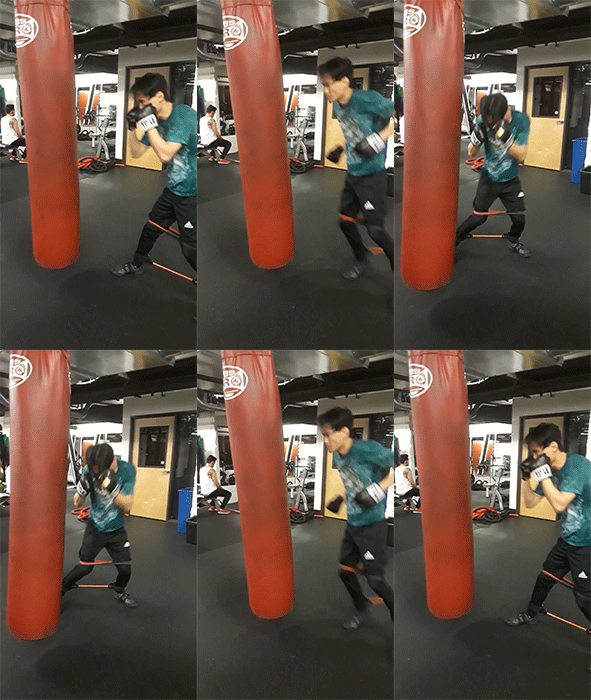
NASM markets its OPT Model or Optimum Performance Training Model as a versatile, scientifically based system that can address fitness goals from clients of any age or skill. Having been involved with martial arts for about 25 years, and embarking in getting certified in Octavio Quintero’s Art of JKD system, I wanted a fitness training system that is accessible to everyone, because I want to help those with or without a martial arts interest.

The OPT Model operates on a three-level block structure with five phases of training. Starting with the foundation of Stabilization, then Strength, and lastly Power on the top.
The Stabilization Level

The first level has one phase of training called Stabilization Endurance that focuses on increasing muscular endurance & stability while optimizing neuromuscular coordination. This phase is proprioceptively based, which means that it progressively introduces greater challenges of stabilization to the body instead of increasing the weight load. A stabilizer muscle is a smaller and weaker muscle than compared to a prime mover muscle. The theory of Stabilization Endurance is to safely produce a strong supporting foundation. If the client’s goal is to develop larger muscle mass, they must have proper Stabilization Endurance before they can they can progress to the higher two levels. From a martial arts perspective, in order to be effective, you need to grounded. An unstable practitioner will not be able to generate power in their strikes and will also lack reliable mobility. Those who wrestle will also suffer from a lack of stability, because good leverage is dependent on grounding and proper structure. The first level of the OPT Model is an excellent choice for those who have a goal of improving muscular endurance, joint stability, flexibility, posture, stability, and coordination. Inefficient stabilization will lead to injuries, something that I have learned the hard way. Skimping on foundational training in the pursuit of fast results can lead to muscle imbalances that stress the skeletal system and overloads soft tissues. Injuries can set back goals by two-folds or more, so from this perspective “slow” is actually “faster”. Have you ever been slowed down by going too fast?

Resistance Exercises for Stabilization

  1. Multiplaner Step-Up to Balance: Standing on one leg is a great exercise to challenge your stability, which is used by many Chinese martial art systems. Climbing the stairs is a great way to increase your muscle endurance in your legs. This exercise has elements of both.
  2. Ball Dumbbell Chest Press: The stability ball activates stabilizer muscles such as your core, upper back, and biceps.
  3. Multiplaner Single-Leg Box Hop-Up with Stabilization: As the name of the exercise suggests, it trains stability by launching and landing on one leg, but it can also train power depending on the explosiveness of the practitioner.

The Strength Level

The second level has three phases of training:

  • Phase 2: Strength Endurance
  • Phase 3: Hypertrophy
  • Phase 4: Maximal Strength

The focus of the second phase is to maintain the first level while increasing prime mover strength. Those who train in this phase are looking to improve stabilization endurance & prime mover strength, joint stabilization, and lean body mass. The third phase addresses those who have goals of increasing maximal muscle growth, while the fourth phase works toward the goal of maximal prime mover strength. Strength training in martial arts can be a heated debate that can have many opposing opinions and several different paths of focus. If we have to use Mixed Martial Arts as a litmus test, there are just as many successful athletes who focus on strength training as to those who don’t. What I continually admire about martial arts is the diversity in disciplines. What are your thoughts on strength conditioning within martial arts?

Resistance exercises for Strength

  1. Barbell Squat: This exercise focuses on the prime movers of the gluteals & quadriceps, but also help work the abdominal stabilizers.
  2. Flat Dumbbell Chest Press: This exercise works the prime mover of the pectoralis major.
  3. Seated Cable Row: This exercise works the prime movers of the lats and rhomboids.

The Power Level

The last level of training requires the first two levels of training as higher loads have higher demands on the body and will lead to injuries without training in the first two levels. Those who train in this level have goals of enhancing neuromuscular efficiency, prime mover strength, and increased rate of force production. Phase five uses traditional strength training superset with power exercises (light load performed as fast as possible). The concept of Power within martial arts is an interesting topic for me. There are a lot of different philosophies on how to create power, but I’d like to generally contrast external force versus internal force concepts on how to generate power. If we take the power equation of force times velocity equals power, external based styles can increase their force by increasing their body mass, though will generally be at odds of being able to increase their speed. Another external method will focus on increasing force by using postural structure that uses the ground’s force (or borrowing the Earth’s mass) as well as exercises designed to increase their speed. Internal methods can be greatly different from external methods. Of course, there are styles that can be both external and internal, but the crux of the difference revolves around relaxation to create “soft power”, because tension kills velocity. This method will also focus on minimal muscle contractions that relies more on skeletal, tendon, and fascia strength. There are other philosophies that go into the realm of the esoteric as these types of martial arts are ancient in origin, which can be challenging to discuss in our scientific western world. However, there are emerging peer-reviewed studies that force us to question what we think we know about the human body and the world we live in. How about you, do you hold unpopular beliefs that buck our scientific conventions?

Resistance exercises for Power

  1. Squat Jump: This exercise is a great aerobic and plyometric workout that builds explosive jumping power utilizing contraction-velocity.
  2. Rotation Chest Pass: This exercise builds explosive power in the prime mover of the pectoralis major utilizing contraction-velocity.
  3. Soccer Throw: This exercise promotes explosive power in the prime mover of the shoulders utilizing contraction-velocity.
Filed Under: Blog, Fitness & Health, NASM CPT Certification Training

NASM CPT: GUIDED STUDY COURSE – Module 1

January 14, 2020 by danma 1 Comment

Introduction and Resistance Training Concepts

  • Read Chapters 1 and 13
  • Read Chapter Reviews
  • Watch the Module 1 Lecture Videos
  • Review the Exercise Library
  • Practice with the Module 1 Activities
  • Answer the Module 1 Discussion Question: The Versatility of Martial Arts Practice Using the NASM’s OPT Model
  • Complete the Module 1 Quiz with a score of 80% or higher
  • Study the Module 1 Flash Cards

Filed Under: NASM CPT Certification Training

NASM CPT: GUIDED STUDY COURSE – Course Textbook Notes

January 14, 2020 by danma Leave a Comment

Course Textbook Table of Contents

SECTION 1: Fundamentals of Human Movement Science

  1. The Scientific Rationale for Integrated Training
  2. Basic Exercise Science
  3. The Cardiorespiratory System
  4. Exercise Metabolism and Bioenergetics
  5. Human Movement Science

SECTION 2: Assessments, Training Concepts, and Program Design

  1. Fitness Assessment
  2. Flexibility Training Concepts
  3. Cardiorespiratory Fitness Training
  4. Core Training Concepts
  5. Balance Training Concepts
  6. Plyometric (Reactive) Training Concepts
  7. Speed, Agility, and Quickness Training
  8. Resistance Training Concepts
  9. Integrated Program Design and the Optimum Performance Training™ (OPT™) Model
  10. Introduction to Exercise Modalities
  11. Chronic Health Conditions and Physical or Functional Limitations

SECTION 3: Nutrition and Supplementation

  1. Nutrition
  2. Supplementation

SECTION 4: Client Interaction and Professional Development

  1. Lifestyle Modification and Behavioral Coaching
  2. Developing a Successful Personal Training Business

Filed Under: NASM CPT Certification Training

NASM CPT: Guided Study Course – Getting Started

January 14, 2020 by danma Leave a Comment

CPT Terms & Conditions

  • CPT Candidate Handbook
  • My CPT Exam will expire 180 days from date of purchase and will be subject to an extension/retest fee if more time is required

Getting Started

  • Click here to watch the Guided Study Course Navigation Video
    • The Candidate Handbook has info the perquisite of CPR & AED certification prior to the CPT exam (NASM will not accept a CPR/AED certification card from an online only provider). I must take the CPT certification exam within my initial enrollment period (180 days from the date of enrollment)
  • Watch the Welcome to NASM-CPT video
    • Each module requires 1 discussion question & quiz
    • Midterm exam: Module 5
    • Final exam: Module 10 (I must get a score of 80% or more on the Final Exam of the Guided Study Program)
    • Schedule your exam no later than 2 weeks after my Guided Study course
    • Success Coach: 1.866.294.6781 | studentsuccess@nasm.org
  • Respond to the question within the Student Lounge
    • Separate groups: 10 weeks, Start: 01/21/20 End: 03/30/20 (There are no discussion topics yet in this forum)
  • Review the Course Syllabus
    • NASM Guided Study Mentor: Your Mentor’s role is to facilitate and grade the discussion question responses and answer any questions you have to clarify concept topics. The Mentors will communicate through the Q&A Forum within the Getting Started Module of the course.
  • Review the Candidate Handbook
    1. Job Guarantee
      1. You must pass my NASM CPT Certification exam with a score of 70% or higher
      2. You must apply to at least 3 employers of personal trainers within 50 miles of my primary residence.
      3. You must complete and submit the Job Guarantee Request form within 90 days of successfully completing my NASM CPT Certification Exam.
      4. If you qualify, you will be refunded only the amount that you paid for the Job Guarantee.
        1. To claim your refund, you must complete the Job Guarantee Request Form and submit via email to trainerdevelopment@nasm.org.
    2. Your name must match the name you use on government-issued identification.
  • Review the Q&A Forum
    • Separate groups: 10 weeks, Start: 01/21/20 End: 03/30/20 (There are no questions yet in this forum)
  • Review the News and Updates Forum
    • Separate groups: 10 weeks, Start: 01/21/20 End: 03/30/20 (No news has been posted yet)
  • Download your Course Textbook
  • Download the Study Guide located in the NASM-CPT Study Guide Module

Filed Under: NASM CPT Certification Training

Kung Fu: Fightable/F**k Objects!

January 1, 2020 by danma Leave a Comment

While going through some of my old files I uncovered an essay I wrote while in art school about similarities between the genres of kung fu films and pornographic films, and I thought it would be relevant to include here.


For the purposes of my own interests and entertainment, I would like to make an extreme association between the genres of kung fu films and pornographic films.  In doing this I will do an analysis of kung fu films and its influences in the US to address certain images & representations and the prevailing ideologies that exists.  It is especially important in relation to kung fu films to realize that while the individual characters of these films may not outwardly project sexuality, it is the modality of these films, as a vehicle of sexual interaction to a voyeuristic audience.  What I am alluding to is the gaze of the ‘other’, and to look at something taboo, the scopophilic perversion of consuming images of something unlike your self.

“I shall be calling Orientalism, a way of coming to terms with the Orient that is based on the Orient’s special place in European Western experience…one of its most recurring images of the Other.”

E. Said, Orientalism, p. 1

It is the objectification of these carnal acts, through this seemingly harmless medium, that we a get a sense ‘otherness’.  When watching pornography, you generally have two types of devoted audiences, one who is viewing for the pleasure of carnal acts (sexual action), and the lesser who watches for the absurd dialog and the expected kind of kitsch that they provide, i.e. porno-tongue.  Kung fu audiences generally function in the same sort of manner.  An individual may sit in front of the screen with their kung fu grip mimicry, for masturbatory purposes, does not watch kung fu films for good plots, but for the pleasure of carnal acts (kung fu action).  In the same turn, one might be inclined to watch kung fu flicks for its’ bad plots, absurd dialog through bad subtitled translation or poor English dub-ins, i.e. porno-tongue.  Porno-tongue is a disconnection of translation and not a reference to the physical tongue-action itself, nor the scripted “talk-dirty” during carnal actions.  Porno-tongue happens in the badly scripted dialogs of pornography, because while the actors may appear to be serious, to the viewer it is still just a pretense to the carnal acts to come (pun not intended, but enjoyed).  In kung fu films, porno-tongue also happens in English dub-ins, where the disconnection of belief is lost in the faith of translation.  Porno-tongue is especially prevalent in Eastern movies reformatted for Western audiences.  It is not common to poke fun at the mismatched lips to audio speak to a Western to Western reformat.  Porno-tongue is essentially a kung fu and pornographic film phenomenon.  Porno-tongue is a disconnection, thus enforcing and alluding to the fantasy, which is explored and fetishized.  Bad plots are disposable, because their function is for one purpose; they lead to the carnal acts.  The genres both have climaxes (the money shot); one is more figurative and one is much more literal.  Both can be reduced to a similar vehicle that drives certain fetishized fantasies, because both illustrate the dominance of race/gender of the consumed for the consumer.  Kung fu in this context, is both amusing and a shameful reminder of ethnicity. Fantastic twists of the body and flashy gestures of swords & spears, kung fu still embodies a primitive form of weaponry to an industrial nation. Both are generally rehearsed and/or choreographed for entertainment.

Kung fu flicks got its’ first big kick in the US with Bruce Lee, so much so, that when you think of him you think of his action—his kung fu action, which is interesting, because when ever you think of any popularized porno-star, you think of their action as well.  Bruce Lee began his career in the US as Kato in the Green Hornet (1966 – 1967), as a masked ass-kicking chauffeur/sidekick for the protagonist, the Green Hornet (Played by Van Williams).  Kato, a name most likely to be recognized as Japanese, is an interesting character role considering the Japanese invasion in 1941.  In The Green Hornet, we have a faceless oriental that is subservient to a white-male who also dawns a mask, but has a double-identity as an unmasked newspaperman (Britt Reid).  Van Williams was fortunate to have character development in not one, but two roles, while Bruce Lee was simply a vehicle to project a post-Pearl Harbor houseboy.  Bruce Lee’s lines consisted of one-line, pidgin-speaking Tonto-like utterances, thus following the trend of a faceless and mono-toned immigrant.  Kato’s subservience only mirrors “Little boy’s” impact on Hiroshima as a celebratory victory over another race that was considered a threat; i.e. in reference to the economic climate of the automobile industry, and of course the Pearl Harbor tragedy.

“Anyone resident in the West since the 1950s, particularly in the United States, will have lived through an era of extraordinary turbulence in the relations of East and West.  No one will have failed to note how the “East” has always signified danger and threat during this period…If the world has become immediately accessible to a Western citizen living in the electronic age, the Orient too has drawn nearer to him, and is now less a myth perhaps than a place crisscrossed by Western, especially American interests.”

E. Said, Orientalism, p. 26

When The Green Hornet was canceled in 1967, Bruce Lee had high hopes in starring in Kung Fu, a television series that he originally conceived, but the leading role of a Shaolin monk roaming the old-West in search of his father went to David Carradine.  Carradine as Shaolin monk, who is by no means a man to be mistaken as an oriental man, only helps to drive the mythology that the white-man can do anything, and not just anything, but better.  This 70’s television series shown on ABC and produced by Warner Brothers is essentially a vehicle of Orientalist ideology marketed towards a white-male audience for an Oriental-fetish gaze.

“Orientalism…is not an airy European fantasy about the Orient, but a created body of theory and practice in which, for many generations, there has been a considerable material investment.  Continued investment made Orientalism, as a system of knowledge about the Orient…”

E. Said, Orientalism, p. 6

After Bruce Lee’s disappointment in Kung Fu, he went back to Hong Kong and had an amazing career in Hong Kong action films that led to international recognition.  Soon after, Hollywood approached him and produced Enter the Dragon, which became a hallmark of kung fu cinema.  Bruce had a mysterious death before the release of the soon to become mega-blockbuster.  During the hiatus of Bruce’s absence from the martial art world since 1973, a myriad of American martial art films cropped up and flooded the scene, and as well as the popularizing of Hong Kong film imports that were either subtitled or English dubbed.  Such movies and stars that arose and became popular are:  The Karate Kid trilogy, Jackie Chan, Bruce Lee clones; and the white muscles of Steven Seagal, Jean-Claude Van Damme, and Chuck Norris.

Images and representations of Asian-males generally are: mysteriously evil, nerdy, homosexual, homoerotic, sexually inept, and/or asexual.  In the case of kung fu films, the protagonist is almost always asexual, while generally the bad guy is mysteriously evil, homosexual, and/or homoerotic in some manner.

“…Bruce Lee in his mega-hit Enter the Dragon was precluded from having any interest in women, unlike his white (John Saxon) and black (Jim Kelly) co-stars.”

T. Fong, The Contemporary Asian American Experience, p. 176

Even in Bruce’s Hong Kong produced films, he had very little or no interest in women.  It is a striking polarization that the hero/protagonist is depicted as sexless, and yet the mode of presentation resembles the style of pornography.  It is important to recognize Hollywood productions from Hong Kong productions and the time that these films were made, because what is generally accepted as appropriate now was not then.  Hollywood productions may favor the protagonist-hero to have sex-appeal, but as far as a foreign protagonist-hero it was considered greatly taboo for a white-male heterosexual centric audience to be excepting during those times.  Producers thought it was shocking to have an Oriental face for the protagonist, and it was for these reasons that Bruce Lee did not get the lead role in the television series, Kung fu.   To have a libidinal foreign hero was too inappropriate, thus the natural progression for the Oriental protagonist has always been focused in a framework of sexless servitude towards righteousness, justice, and/or the institution of, which the conflict is always resolved through kung fu action.  This is strikingly similar to Hong Kong produced films.  Many of the Hong Kong productions during the Bruce Lee era had the same framework of a sexless hero.  This may be accounted for stereotypical notions of heroism in the East.  I believe religious practices to be a heavy factor in shaping ideologies of what an Eastern hero is supposed to imbue.  After all, kung fu was born from the Shaolin temples, to which these monks were devoted to, but as well as the practice of Taoist, Buddhist, or a sects of Buddhist religion.  Confucianism has long been a substrate for shaping sentiments of morality in the East, in which moral men put the institution/community before personal desires.  Jackie Chan’s movies, whether US or Hong Kong produced, follow the similar vain of a sexless hero except there is a certain level of low-brow humor that is very similar to a lot of other kung fu movies.  Here is a back-cover description of Rush Hour 2:

“Last time they nearly destroyed L.A., now they’re about to break China!  Jackie Chan and Chris Tucker reprise their roles as mismatched detectives in this smash-hit fellow-up that’s even “faster and funnier than the first!”  (Peter Travers, Rolling Stone).  Reunited in Hong Kong, the two cops look forward to a much-needed vacation, but their plans go up in smoke when a bomb explodes in the American Embassy.  Suddenly, they’re tracking a group of slippery suspects, including a beautiful assassin (Crouching Tiger, Hidden Dragon’s Zhang Ziyi) and a mysterious mobster (John Lone, The Last Emperor).  With their irresistible mix of head-spinning action and gut-busting comedy, Chris Tucker and Jackie Chan they’re the team to beat in this can’t-miss movie that delivers the entertainment rush of the year!”

B. Ratner, Rush Hour 2, back cover

Chris Tucker and Jackie Chan team together again, to battle what seems to be a never ending orgy of faceless bad guys.  In Rush Hour 1 and 2, there are striking polarities in the protagonists.  Inspector James Carter, played by Chris Tucker, is loud & obnoxious, sings well in English, dances like Michael Jackson, is womanizer, doesn’t respond to authority well, and has a personification of cool as in himself.  Inspector Lee (has no first name), played by Jackie Chan, is none of those things described of James Carter, but in fact quite the opposite.   Inspector Lee isn’t cool in himself, and if he is cool in some manner, it is only because of kung fu.  Both embody a clownish representation of race.  Chris Tucker can’t be taken seriously because his character is full of shit most of the time, and Jackie Chan acts as the serious role, but his awkward representation of Asian ethnicity makes him a center of laughs as well.  Rush Hour and its’ sequel follow the “good cop/bad cop” routine of the likes of the Lethal Weapon trilogy, except both the protagonists scream stereotypes.  Besides the action scenes, the movie is carried by the differences of race and ethnicity through stereotypical jokes.  While it may be all fun and light-hearted there are many faces and voices of African-Americans to give a broader sense of blackness.  One might think about the level of representation for Asians, and more over, the level of representation for Asian-Americans.  Master with Cracked Fingers (1974) is one of Jackie Chan’s earlier works before he became famous in either the US or in Hong Kong.  This Hong Kong production also follows the similar framework of sexless servitude towards righteousness and the low-brow humor.  There are two instances of sexuality in this movie.  In one scene there is a gang-bang of kung fu thugs who attempt to rape a woman, which is actually a trap for Jackie who is of course victorious over their trickery.  Earlier in the movie there is another instant of sexuality where Jackie is a little boy who wants to learn kung fu, and happens to run into a Chinese hobo who would later become his kung fu master.  His master tells little Jackie to take off his cloths and get into a bag full of snakes.  The little boy is reluctant, but eventually submits to his master’s request, which he then cries when he gets in.  One with little imagination might think this is very strange, and by American standards is a suggestion towards pedophilia.  The voices are also dubbed over in English, which gives a certain quality of disconnect and kitsch.

“…must locate himself vis-à-vis the Orient; voice he adopts, the type of structure he builds, the kinds of images, themes, motifs that circulate…all of which add up to deliberate ways of addressing the reader, containing the Orient, and finally, representing it or speaking in its behalf…The things to look at are style, figures of speech, setting, narrative devices, historical and social circumstances, not the correctness of the representation nor its fidelity to some great original.”

E. Said, Orientalism, p. 20 – 21

Filed Under: Martial Arts

A Way of Being

November 25, 2019 by danma Leave a Comment

I saw an interesting interview on John Kaufman about wing chun and his method of generating power through relaxation. He said something that stuck with me.

“…it’s not about what to do, it’s about how to be.”

John Kaufman

The internal methods that I am learning in Lightening Hand Academy is counter to a lot of the violence and competitiveness that I am seeing in the world today. It has been a very good experience for me to have something in my life that helps provide an antidote to feelings of competition and the violence that it brings.

I have been having conversations with a friend, who likes boxing, about traditional kung fu and MMA. If you don’t know, there are a lot of MMA opinions that wing chun doesn’t work in the ring and that there are a lot of fake martial arts coming from kung fu. There are also a lot of “experts” who hype combative sports as a means of self defense. Then there is the debate of wrestling on the streets for self defense. My conversations with him about stuff like that have been lively, but I do understand where he is coming from. It is hard to understand the internal arts if you don’t experience it, because you can’t see it, and to watch internal training is like watching someone knit a sweater.

Since I don’t see myself competing in a cage, I could go my whole life without ever using kung fu to defend myself. I really like the idea that wing chun is a way of being. Perhaps relaxation leads to the first line of defense: staying clear of trouble.

Notes From Last Class

I lucked out and had Wesley (Sigung’s son) teach me a lot of things:

  • gave me technical insights on the siu lim tao
    • opening the elbow to uproot your partner
    • different hand positions
  • went over the whole chum kiu form
    • taught me how to correctly turn
    • opening the elbow to uproot your partner
  • dan chi sau
    • fook sau adherence to your partner’s arm by opening the wrist joint on the side closest to the pinky
    • opening the elbow to uproot your partner
    • the jut sau:
      • heavy elbow locks the shoulder down and slightly opens
      • the wrist open up as you point up
  • moving and concealing your center

Filed Under: Blog, Wing Chun

« Previous Page
Next Page »

Primary Sidebar

  • Somatic Performance
  • Wellness Coaching
  • About
  • Blog
  • Contact

ReGroove Fitness | Somatic Personal Training in Portland, OR


Loading Comments...