• Skip to primary navigation
  • Skip to main content

ReGroove Fitness

by Wellness Coach Dan Ma

  • Somatic Performance
    • Martial Movement
    • Skill-Based Exercise
  • Wellness Program
  • About
  • Location
  • Testimonials

workshop

The Big Dipper Ceremony Workshop by Master Zhongxian Wu

December 27, 2017 by Dan Ma Leave a Comment

In anticipation of Master Wu’s workshop we started doing a little more research into the Big Dipper and Taoist astrology. I found a number of online references and the one that I found most interesting is Master Chia’s Taoist Nine Star Astrology, which I found to be not extremely dense, but more dense than I wanted it to be. The theory as I can best understand it is that the Earth’s movement and energy patterns are based on the energy fields of nine points that comprise of:
  • The Vega Star (1 point)
  • The Big Dipper (8 points)
  • The North Star (1 point)
The North Star is the Earth’s boss star, which the boss changes about every 26 thousand years when the Earth’s axis changes (axial precession). Currently the Earth’s boss star is Polaris, which is considered a yang star. Our next North Star is Vega, which is a yin star. There is also Thuban, which was our last boss star and is considered a neutral star. In this article it also talks about a Nine Star Chi Theory, where it theorizes about nine distinct electromagnetic phases that occurs from a wobbling on the Earth’s axis (not to be confused with axial precession). These slight wobbles changes the relationship of the Earth’s North/South polarities to the nine points (Vega, Polaris, and the Big Dipper), which then affects the human electromagnetic field. Each star has an important and integral part of each of the nine electromagnetic phase, so during each transformation phase certain stars are accentuated. Transformation phases encompases:
  • 5 Fire Years
  • 5 Earth Years
  • 5 Water Years
  • 5 Wood Years
  • 5 Metal Years
These transformation phase are represented within the nine year cycle, and each year is either a yang or a yin. The article also goes on to talk about a Nine House Astrology, which has something to do with how humans during their lives migrate through the yearly, monthly, daily, and hourly sequences of transformations. The Earth has ten branches, which are five yang energies elements and five yin physical elements. I think these have something to do with the I-Ching Pakua. Nine Directions and Five Elements:
  1. Water (+)
  2. Earth (-)
  3. Wood (+)
  4. Wood (-)
  5. Earth (+ & -)
  6. Metal (+)
  7. Metal (-)
  8. Earth (+)
  9. Fire (-)
Using the Magic Square, these formations can be converted into Sacred Geometry:
4 9 2
3 5 7
8 1 6
This Magic Square has something to do with the movement of the spiraling Universe. The rest of the article goes into mathematical detail how the I-Ching Pakua uses the Magic Square to calculate the nine year cycle of your life. I also found interesting information about the Big Dipper in relation to the Swastika. Of course the Nazis appropriated the symbol for their own cause, but if you don’t know, he Swastika is an ancient religious symbol that dates as far back in Hinduism, which is the oldest known surviving religion in the world.

The Big Dipper Ceremony

Veronica and I first learned of the importance of the Big Dipper in relation to Taoism came from Mantak Chia’s Portland workshop in 2017 and his Awaken Healing Light Meditation where you connect with the Big Dipper and collect it’s red energy into your body. This year we went to Master Wu’s Big Dipper Ceremony on December 8, 2017 at the Motion Massage Studio in Portland, Oregon. This would be the second Master Zhongxian Wu workshop that we have been to.  Just after stepping inside the venue, we were visually greeted with battery powered candles on the floor in a dimly lit yoga studio. The candles were arranged on the floor similar to the graphics of Master Wu’s Chinese Shamanic Cosmic Orbit Qigong book, which looks like two Big Dippers, one mirrored on top of each other. The ceremony consisted of:
  1. Sitting mediation
  2. Circle walking
In the sitting meditation we used a Big Dipper hand mudra as we repeated a chant from Master Wu, which I cannot remember and was not allowed to record. We also visualized the pattern on floor of two Big Dippers in our tan tien. The circle walking was very similar if not exactly the same to the baguazhang circle walking. Baguazhang is a form of internal martial arts that can be thought of as Tai Chi Chuan, and Hsing-i Chuan. We circle walked around each candle on the floor for as many revolutions as we liked. It was interesting feeling the energy charge of the room change during the ceremony. Veronica especially felt a difference when Master Wu participated in the circle walking. After the ceremony we enjoyed conversations with others in the workshop. We had an enjoyable conversation from someone who came all the way out from San Francisco to participate. For the cost of $50 bucks for the both of us, it was a well worth experience.

Filed Under: Event Reviews, Events & Workshops Tagged With: Learning Meditation, Learning Taoist Meditation, Master Wu, Work shop, workshop

How Soon Is Now? Visioning workshop with Daniel Pinchbeck

April 4, 2017 by Dan Ma 1 Comment

I was visiting New Renaissance bookshop in northwest Portland, Oregon, as I frequently do, to have a look around. Dan and I were curious what meditation cushions went for. It turns out, we might resort to making our own, because these are some gourmet cushions with gourmet prices. As I was looking across the display of crystals and semi-precious jewels and jewelry, I overheard a clerk say to a customer, “We have a workshop with author Daniel Pinchbeck today at 2 o’clock!” I immediately felt a surprising gush of uncharacteristic adrenaline in my body. I didn’t realize I felt so strongly about an author who wrote a book I really enjoyed reading over 7 years ago. I had a lot to do that day, so I didn’t sign up for the workshop, despite my weirdly visceral reaction (and by weird I employ both the original meaning of weird to mean magically affected and the contemporary use as in strange). I went to my studio and worked steadily on a ceramic hand-building project for a couple hours, debating on whether to attend the workshop. The adrenaline didn’t subside. I discussed it with Dan who mentioned that perhaps the workshop would be beneficial beyond meeting an author and idea machine who I admire, either as something interesting to write about, or as an idea generator for my art practice. I was oddly nervous, so nervous that I didn’t want to call the bookshop to sign up for the class because I didn’t want to talk to a stranger over the phone. I think I had performance anxiety. I looked forward to talking to Daniel Pinchbeck about a lot of ideas I’ve had in response to his previous books, but tend not to speak well in front of crowds, and Portland is full of a lot of brilliant minds who I’m sure would fill up this workshop. My chattering monkey mind reasoned the workshop would sell out and I wouldn’t have a seat. So, Dan called and signed me up for the workshop. I walked the 7 blocks or so from my studio to the bookstore and browsed for distractions while waiting for the workshop to start, still trying to get a handle on my nerves. What in the world was triggering such nervousness? I thought I’d look at a book of bird’s eye view photos of the Earth to calm myself, but the book, as I flipped through, was about human impact on the Earth. Full spread aerial photos of strip mines, sprawling suburban developments divided into neat squares of green, agricultural grids, and shorelines cluttered with fishing vessels. Every image made me feel more anxious. I put the book back and doused myself with a rose water sample.
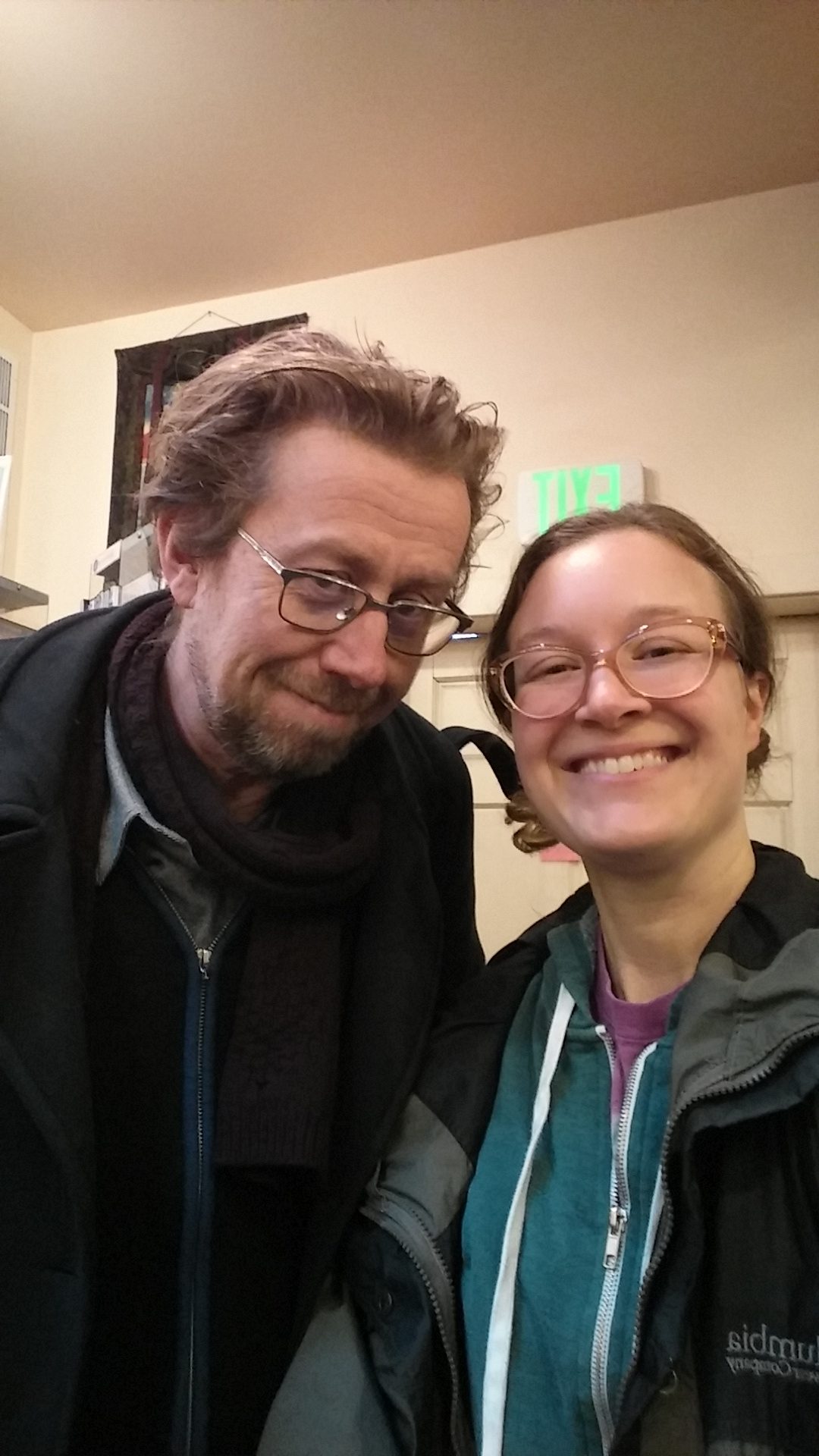
Daniel Pinchbeck and Veronica Reeves
Finally it was starting time. I walked into the New Renaissance event center, one of four historic looking houses that the bookshop had converted into its business space. There was a semicircle of about 12 chairs facing a stool and a white board on an easel. Surrounding the space, on the walls, were about 20 large framed prints of portraits of spiritual leaders/icons including Paramahansa Yogananda and Sri Yukteswar. A couple who looked to be in their 60s (I’m horrible at guessing ages) came in before me. We were joined by a friend of theirs who I learned had a hand in developing the legalization of marijuana in the state of Oregon. Then entered a lady who worked as an energy healer, another woman who worked in shamanic medicine, and one of the bookstore clerks (the one who I heard talking about the workshop earlier) who is also an artist joined us, and of course Daniel Pinchbeck whose demeanor was uber relaxed and without pomp or pretension. This, I discovered, was not what I expected. Maybe my expectations rose from previous experiences having studio visits with mid-career artists who act like they have to prove how intelligent they are, and end up being inaccessible, often making for a disappointing, one-way conversation. Whatever the reason for my expectations and nervousness, they weren’t validated here, thankfully, and I was able to focus on the ensuing discussion. This guy reminded me a lot of when I saw Ringo Starr in concert. Ringo did not put on the rock star charade, he made the entire auditorium full of people of all ages comfortable, so comfortable that none of us felt too inhibited to participate in a full scale sing along of Yellow Submarine while both hands were up in the air waving peace signs back and forth. 
At the Ringo Starr concert with my son. PDX 2016
Pinchbeck introduced his new book to us, How Soon is Now? -which I have just barely begun at this point (and hadn’t even known about before the day of the workshop). The big question that we started off with for discussion was, what are our goals? Pinchbeck noted how the Right Wing Republicans, who are now very much in control of the U.S. government, have very defined goals. Those of us who are alarmed by most if not all of these goals should define our goals in concrete visualizations. Although these goals are being enacted in the face of outcry, blatantly ignoring critical plights of ethics, Pinchbeck recognizes our travails as a nation as a “rite of passage” for humanity, a learning opportunity that will propel our “mature responsibility” as a species. He identifies these major issues as a “karmic comeuppance for the U.S.” and a “contraction before the next push.” Our group discussed what we could do to accelerate this maturity, or small steps we could take to create new models ready to go once this current model (an aggressive, competitive economy of unrestrained growth) finally bites the dust. I have been musing on this question for a long time, along with so many like-minded friends and colleagues. I thought of my friends and fellow alumni within Signal Fire, a nomadic residency with an environmental activist and outdoor skills curriculum for artists and creatives. I have wondered, how do we survive when we experience complete system collapse? At home, Dan has made a couple raised garden beds (dependent on a water supply) and a small, indoor aquaculture system (dependent on electricity). How do we overcome the reliance and helplessness we have complied with? This is part of the danger that presents opportunity for what Pinchbeck refers to as evolutionary growth. My version of this question is how to make people feel safe and encouraged enough to rely directly on the Earth rather than relying on the feeble, destructive, man-made systems that create poverty for many and wealth for few (while gobbling up Earth’s resources)? Pinchbeck illustrated three human structures that interact with each other and affect the reality we are participating in. Imagine these structures looking like gears that interlock to spin the others and contain within them contemporary practices or apparatuses: Technical Support Systems (energy, agriculture, industry), Social Systems (government, economics), and Consciousness (culture, media, education, religion). So, the question posed to us at this point is, how would things have to shift for humanity (and Earth) to thrive? Technical Support Systems solutions include actions like switching to renewable energy and reducing CO2 by 8-10%. Pinchbeck points out that we have the technology to replace unsustainable practices, such as farming practices that restore the topsoil, no till, permaculture, biochar (a.k.a. Terra Preta) which is a biomass energy source while also producing fertile tilth. Our group then discussed the prospect of hemp as building material and how if big oil went bankrupt a redistribution of wealth may follow. Pinchbeck referenced Naomi Klein’s Shock Doctrine, asserting, “When a crisis happens, the ideas that replace the failed system are the ones just laying around.” This puts the onus on us to develop and prime these new systems and new ideas. These hopeful systems are being developed and we should be encouraged, but ready to pounce. We are living in a system of “conspicuous consumption and planned obsolescence,” Pinchbeck sites, and goes on refer to Cradle to Cradle by WIlliam McDonahue and Michael Braungart who document reworking production processes to be sustainable, substituting toxic ingredients with benign, biodegradable ingredients, and replacing plastic packaging with compostable/seeded wrapping. The social and environmental accountability of these examples are what is missing from industry practices left over from the 19th century. It’s time to start seeing environmental accountability as social accountability. The woman in this workshop who practices shamanic medicine repeated an amazing statement told to her by an indigenous healer from South America (I forget who and where exactly). When a community has epic struggles arise such as ours we simply need a new vision, or in the indigenous healer’s words, “We are lost because we need to dream a new dream.” Social Systems can be reformed, Pinchbeck posits, through decentralized, participatory government. We can develop these new visions together. Pinchbeck brings together ideas and models from Loomio.org, that facilitate democratic, group decisions, along with the left-wing political group known as Podemos in Spain whose main policies include promoting public control of economy, reducing poverty, instating basic income, redefining national sovereignty, healing the environment, and breaking down barriers of social stigma, increasing equality and liberty. Pinchbeck offered us a beautiful metaphor for our domestic situation in the metamorphic process of a butterfly. The caterpillar doesn’t simply become a skinny caterpillar with long legs and wings, the body of the caterpillar dissolves into a goo of genetic material. Certain cells, called imaginal cells, begin to rebuild the genetic material of the caterpillar. As this is happening, the caterpillar’s immune system cells attack the imaginal cells, which in turn makes those imaginal cells stronger. They finish their job and a butterfly emerges! (I haven’t researched to see if sometimes the imaginal cells are killed off and the caterpillar goo putrefies, but let’s not focus on that). So, we may begin to see that we are living during the process of political change where our burden is now to redesign ourselves, redesign our culture. Pinchbeck turns this into an optimistic venture, evoking “society negates the state” models where the collapse of authority results in cooperative problem solving, such as the Burning Man sub-culture where money isn’t used. He points to Hannah Arendt’s On Revolution, how “revolutions are often ruined by revolutionary leaders” and the importance of allowing people to work together directly, to self-organize. Here, I think about Modern Money Theory, which I know very little about, but find fascinating. Our current value exchange is designed to support competitive behavior. How may we redesign this to support cooperative behaviour? As a group we discussed the problems of corporate personhood, how corporations survive in the stock market game by self selecting sociopathic characteristics. How do we redesign the game to support the ecosystem as well as its workers? Consciousness is affected by social systems and technical support systems, but the reverse is also true. How do we change or expand consciousness? Of course these leads back to meditation. Pinchbeck reiterates sexual liberation as a path to social change and thereby a change of consciousness, and gives us the example of Tamera, Germany, a society that practices free love. I understand the desire for erotic abundance and satisfaction, as well as the results of sexual oppression (see The History of Sexuality by Michel Foucault) but I have doubts that a free love society is our solution here. I see sexuality as an extension of our beings, not an essence. While reading Paramahansa Yogananda’s Autobiography of a Yogi, I became convinced of the relationship between sexual appetite and ego, that desire is an action of ego which produces attachment and discontent. Like any other appetite, if not trained it can result in destruction to the body and become an impediment to spiritual connectivity, right? In the movie Awake that talks about Yogananda’s life, one of his students is interviewed and recounts a conversation he had with Yogananda. To paraphrase, the student points out other religions that spell out a list of do not, shall not items. He asks Yogananda, his master, what may I do? Yogananda asks in reply, “Do you enjoy smoking?” Student: ”Yes.” Yogananda: “You may continue. Do you enjoy drinking?” Student: “Yes.” Yogananda: “You may continue. Do you enjoy promiscuous liaisons with the opposite sex?” Student: “Yes.” “You may continue to do all these things, but I cannot promise you that you will continue to do these things as you progress in daily practice of kriya yoga.” -something like that. I find this very interesting because it suggests that we don’t need anything external to change our actions in this world, we have the kingdom of God and access to inner divinity within. Pinchbeck suggests that we as a species invest in the exploration of outer space as well as inner space. He mentions global synchronized meditation and the evidence of global consciousness, that to thrive, humanity must find ways to sustain and regenerate itself. Too many of us, myself included, rely on these other systems to survive. Consider the medical industry and general knowledge of healing properties of plants. As naturopathy gains popularity, I can hope that this will shift, but in the meantime the general population of the U.S. knows very little about even identifying species of plants, let alone their healing or nourishing value. My gut reaction to this information is to research this topic and produce educational paintings that are also spiritual, reifying the importance of our mother Earth. Personally, as an artist, I have hope that images I produce can evoke healing and inspire empathy and awareness of our connected reality, and when I say ‘our’ I include everything nonhuman as well. As a mother I see the importance of intergenerational community in the variety of wisdom and experience that we humans can benefit from. Not only do children learn from elders but I can attest that I learn something new from my children daily, if I’m paying attention. The practice of meditation allows me to set an intention for my day and to slow things down enough for me to practice being observant, another aspect of being a visual artist that nurtures my being. Meditation helps me address my own complicity in the systems that need to changed, and until I can visualise change in myself, I can’t yet change my actions in the world. However, once I do change my actions in the world, I find I also change my expectations for others and myself. Like humanity on a greater scale, I am going through a rites of passage, but the journey has no final destination, it is a rites of passage that continues and sustains itself regardless of whether I’m making progress or not. If you have read or are reading How Soon is Now? I am interested in your thoughts. Do you think technological and social systems are affecting consciousness? Can we affect change by expanding consciousness? These are ancient ideas and I would like to hear how this manifests in your life at a practical level.  
Shopping at Amazon? Please support Regroove Meditation by using our link, we get a referral commission on anything you purchase.

Filed Under: Events & Workshops Tagged With: Daniel Pinchbeck, how soon is now, new renaissance bookstore, oregon, pdx, Portland, workshop

  • Somatic Performance
  • Wellness Coaching
  • About
  • Blog
  • Contact

ReGroove Fitness | Somatic Personal Training in Portland, OR


Loading Comments...