You’re in the car. Engine off, keys in hand. The day is over — but your body isn’t moving. You’re not crying. Not panicking. Just still. Like the signal to go never arrived.
Or you’re halfway through a workout, and suddenly the reps fade. Your breath catches. You’re here — but not really.
Or you’re scrolling in bed, knowing you “should” get up — but your limbs feel like lead.
This is the freeze trauma response. Not a flaw. Not laziness. It’s survival — the body’s built-in reflex when fighting or fleeing isn’t an option. It’s your nervous system doing its job: conserving energy, muting sensation, keeping you safe.
If you’ve ever felt numb instead of driven, flat instead of focused — you didn’t fail. Your system protected you.
In this article, we’ll explore what freeze really is, how it forms, and what it takes to gently thaw. Not by pushing through, but by relearning safety — one breath, one step, one moment at a time.
What Is the Freeze Trauma Response?
Freeze isn’t a mindset issue. It’s not about motivation or willpower. It’s an ancient, automatic survival response triggered when the body perceives danger — but no safe way out.
Governed by the dorsal branch of the vagus nerve, freeze draws energy inward. Muscles go still. Breath slows or halts. Emotions dim. It’s the nervous system’s version of a system shutdown.
What it might feel like:
- Heavy limbs, foggy head
- Flat affect or emotional blankness
- A sense of being there, but not present
It’s often misread as apathy or calm. But under the stillness is a system working hard to survive.
How the Freeze Response Shows Up in Real Life
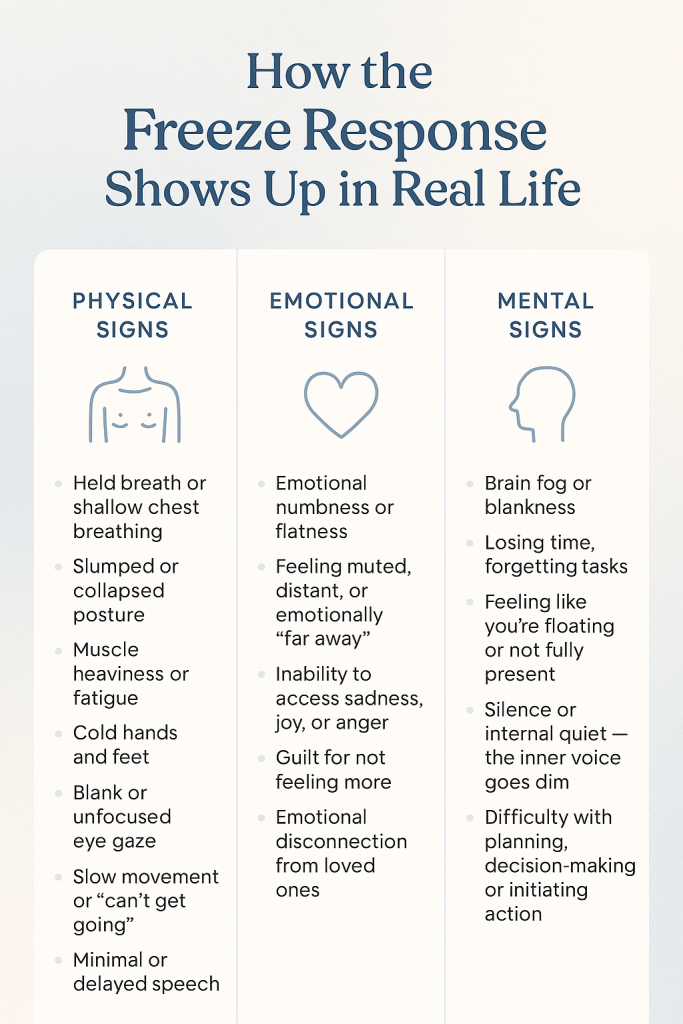
Freeze is often invisible — especially in high-functioning people. It shows up in moments like these:
- Zoning out mid-conversation
- Sitting in a car unable to move
- Going blank during a meeting
- Scrolling endlessly while your to-do list waits
Jason finishes work and can’t send a single email.
“I’m functional all day — then I disappear.”
Rachel parks outside the grocery store but can’t open the door.
“My body is quiet, but I’m screaming inside.”
Eli tries a somatic practice — and goes numb halfway through.
“I shut down in the middle of awareness. Like the light flickered off.”
These aren’t personality flaws. They’re signs of a nervous system trying to stay safe.
Freeze vs. Other Trauma Responses
All trauma responses are survival strategies:
| Response | System Mode | Pattern | Common Feelings |
| Fight | Sympathetic | Confront | “I get angry or intense.” |
| Flight | Sympathetic | Escape | “I overwork or avoid.” |
| Fawn | Parasympathetic (ventral) | Appease | “I say yes to stay safe.” |
| Freeze | Parasympathetic (dorsal) | Shut down | “I go numb or can’t move.” |
| Flop | Extreme dorsal vagal | Collapse | “I lose control or faint.” |
Freeze mimics calm but is inward chaos. Quiet on the outside, overwhelmed inside.
Why Freeze Happens — And Why It Sticks
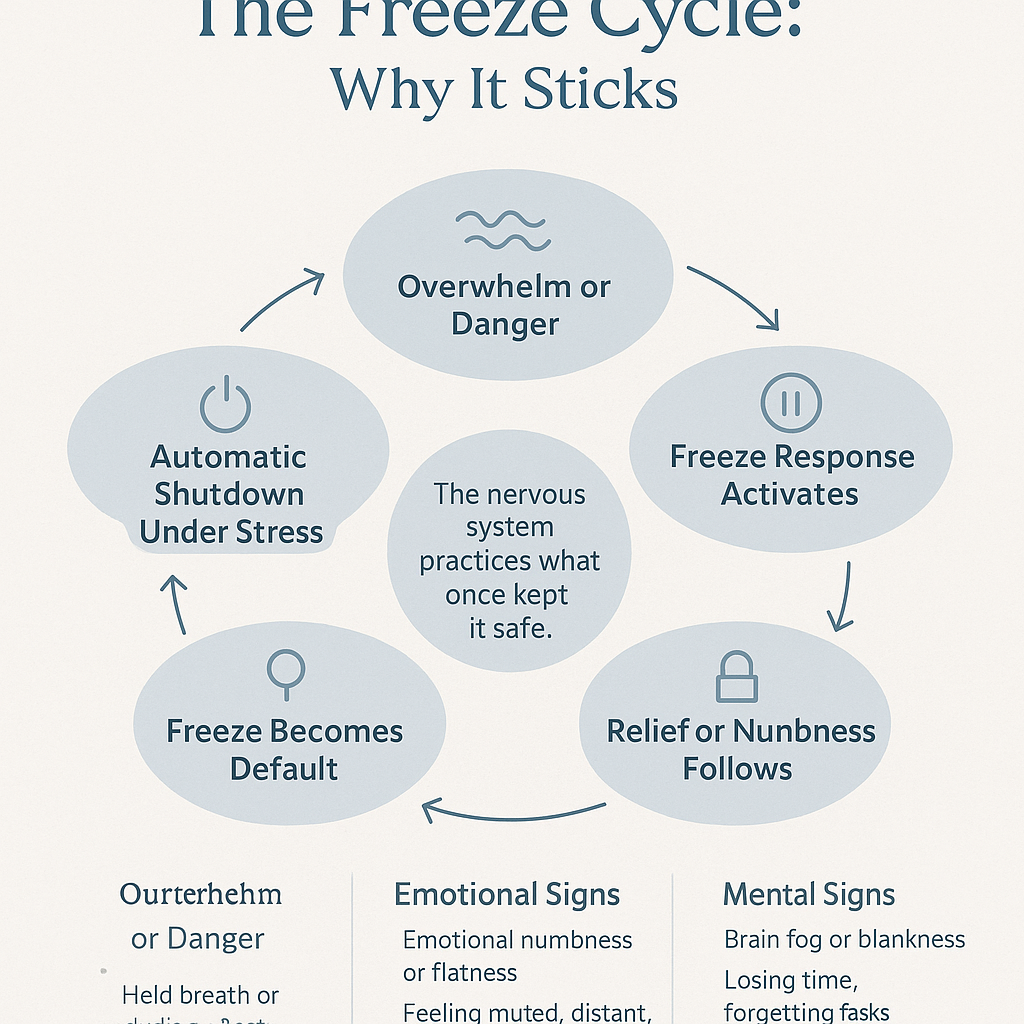
Freeze kept our ancestors alive. Animals freeze to avoid detection or reduce pain when escape isn’t possible. That same circuitry lives in us.
In humans, freeze can become a default — especially if:
- Childhood environments lacked safety
- Emotions weren’t welcomed or mirrored
- Expression was met with punishment or neglect
Your body learned: “Stillness is safer than feeling.”
Over time, freeze becomes the most practiced — and thus most automatic — response.
Jason grew up in a high-pressure home. He achieves, then crashes.
“If I’m not achieving, I don’t know how to exist.”
Rachel learned to care for others, not herself.
“I vanish when I’m not needed.”
Eli avoided emotional conflict by going numb.
“Freeze feels familiar — even when I don’t want it.”
Somatic Recovery: How to Gently Come Back Online
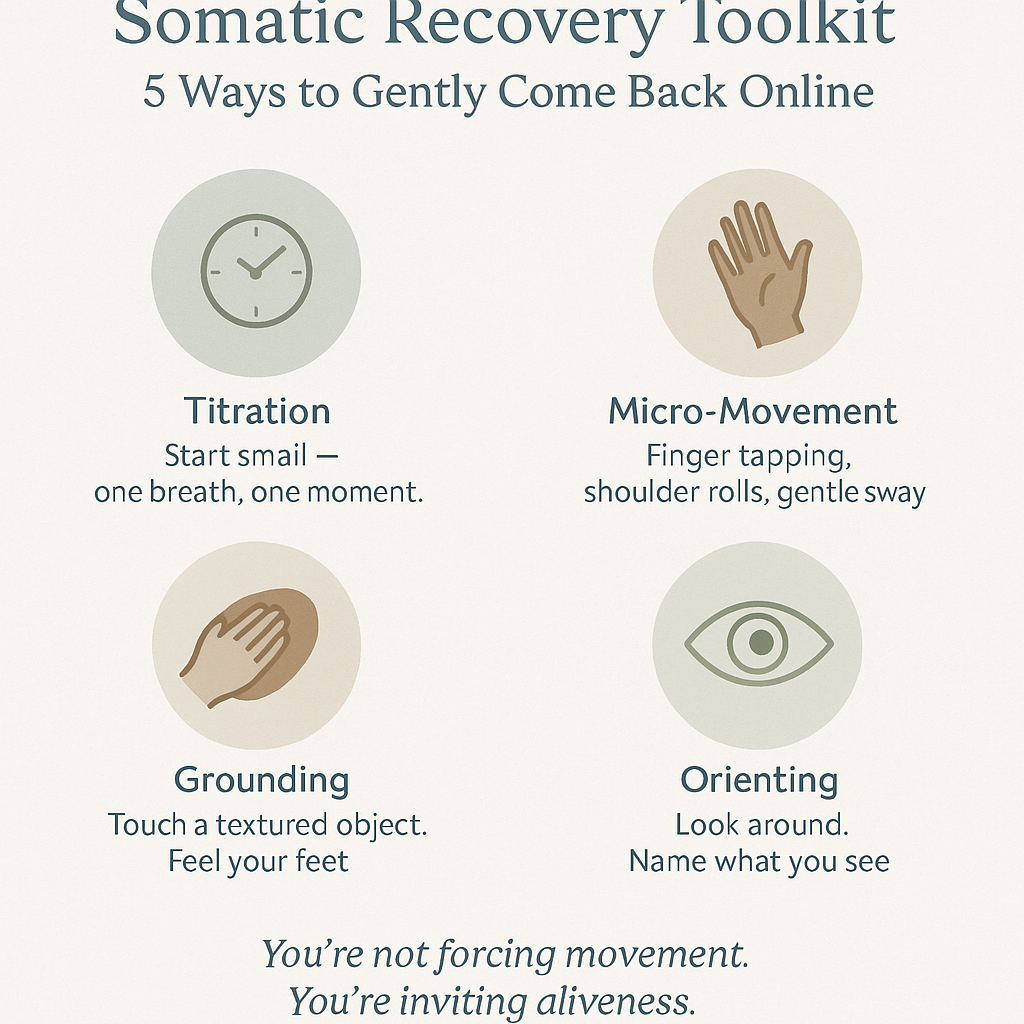
You don’t push through freeze. You thaw out — slowly, with your body leading.
1. Titration
Start with just enough:
- One breath
- A five-second stretch
- Noticing your feet on the ground
“I don’t need to fix it — just feel a little more.”
2. Micro-Movement
Invite subtle shifts:
- Finger tapping
- Shoulder rolls
- Rocking side to side
“You’re not forcing — you’re inviting aliveness.”
3. Grounding
Use sensory cues:
- Touch a textured object
- Feel feet in your shoes
- Track sound or temperature
“Touch brings me back faster than thinking.”
4. Breath
Don’t force breath — soften around it:
- Inhale 4 / Exhale 6
- Hand on belly
- Audible sigh
“It’s like I come back into myself — even just a little.”
5. Orienting
Remind your body you’re not trapped:
- Turn your head slowly
- Look at one neutral thing
- Say: “I see the lamp. I see the door.”
“I can feel myself rebooting — slowly, but it’s real.”
Freeze isn’t melted by willpower. It’s thawed by care, rhythm, and body-based healing — one moment at a time.
When to Seek Professional Support
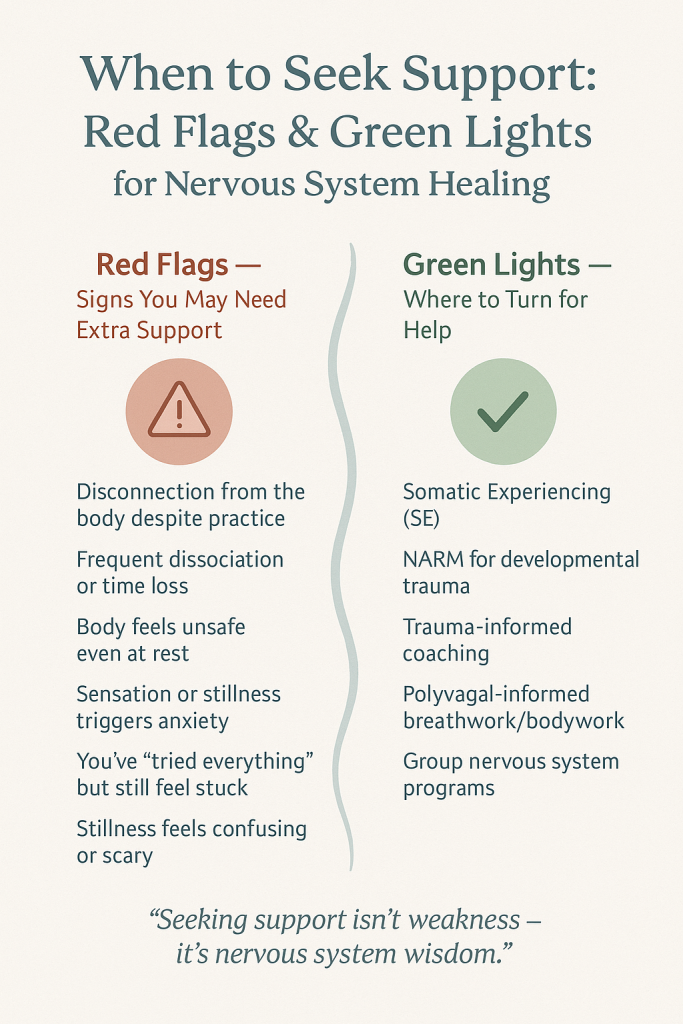
Self-guided tools can help — but some patterns need a witness.
Consider working with someone if:
- You feel disconnected from your body
- You dissociate or lose time
- Sensation or movement trigger fear
- Tools don’t seem to help
Jason crashes on weekends despite high productivity.
“Even when nothing’s wrong, I feel like I’m short-circuiting.”
Rachel tenses during breathwork.
“I don’t feel safe relaxing. It’s like I’m waiting for the other shoe to drop.”
Eli understands the science — but can’t access feeling.
“I know what’s happening, but I can’t reach myself.”
Helpful support options:
- Somatic Experiencing (SE) — body-based trauma work
- NARM — for developmental trauma
- Trauma-informed coaching
- Breathwork and Polyvagal-informed bodywork
- Nervous system-based group programs
“I want help as I come back online” is not weakness — it’s wisdom.
You Froze to Survive — Now You Can Reclaim Your Life
If you’ve felt blank, unreachable, or just off — your body wasn’t failing you. It was protecting you.
Freeze isn’t dysfunction. It’s survival.
And now, you get to choose something new.
Healing isn’t about erasing freeze. It’s about reconnecting — to your breath, to your body, to your life.
Jason pauses before the crash.
Rachel reclaims stillness.
Eli stays with sensation for one breath longer.
These aren’t breakthroughs. They’re returns — to the self that’s been waiting underneath.You are not broken.
You are not too late.
You froze to survive.
Now, you’re learning to come back — on your own terms.
Title Page Separator Site title
Slug
Meta descriptionUse AIInsert variable
SEO analysisEnter a focus keyphrase to calculate the SEO score
Premium SEO analysisPremiumAdd related keyphrasePremiumTrack SEO performanceInternal linking suggestionsPremium
Cornerstone content
Advanced
Insights
Use up and down arrow keys to resize the meta box panel.PostBlock
Paragraph
Start with the basic building block of all narrative.
Block Controls
Block stylesSelect a block styleBlue messageGreen messageOrange messageRed messageGrey messageLeft blockRight blockBlockquotes
This option let you add custom style for the current block
Attributes
All options are currently hidden
Advanced
Skip to the selected blockOpen publish panel
- Post
- Paragraph
Leave a Reply