Where the Flight Response Comes From
You didn’t choose to live in fast-forward. Your body learned to—because it had to.
The flight response doesn’t appear out of nowhere. It’s a pattern, built brick by brick in environments where stillness felt dangerous, and movement felt like safety.
This is survival-based conditioning.
Maybe your house was loud, unpredictable, or silent in the wrong ways. Maybe you became the fixer, the achiever, the emotional buffer. Maybe rest was punished, softness ridiculed, or needs ignored. So your system found a workaround: motion.
Early trauma and the nervous system go hand in hand. Without consistent safety cues—touch, tone, attention—the body stays on alert. This is childhood nervous system development in survival mode.
Attachment plays a role, too. Anxious attachment can wire in a deep fear of stillness. If slowing down meant abandonment or disconnection, then flight becomes the nervous system’s shield.
These are trauma imprints from childhood—not personality traits. And the flight response? It’s a somatic trauma pattern that once kept you safe.
As Polyvagal Theory explains, when the body perceives threat but still has energy, it mobilizes—flight mode. You stay busy, not to thrive, but to avoid collapse.
If your body grew up in a storm, it makes sense that it still wants to keep moving. You learned to ride your nervous system like a bike with no brakes—because it was the only way to stay upright.
This isn’t weakness. It’s brilliance. But now, brilliance can soften into safety.
Where the Flight Response Comes From

The flight response didn’t just appear one day. It was shaped—by what your body lived through.
This isn’t a flaw in your character. It’s a survival strategy your nervous system learned to rely on.
If your early world felt emotionally unpredictable…
If you had to stay two steps ahead just to feel safe…
If stillness got you in trouble, or rest felt dangerous— then flight likely became your nervous system’s best attempt at protection.
These are the quiet origins—the causes of trauma responses that don’t always look like trauma.
You might have grown up in chaos, where calm never lasted. Or in silence so thick, your body learned to fill the space. Maybe you became the fixer, the achiever, the one who held it all together.
That’s not just personality. It’s an early attachment and trauma imprint. A somatic trauma pattern whispering: “Stay in motion, or it all might fall apart.”
According to Polyvagal Theory, this is what happens when the body loses access to safety. Without co-regulation or stable connection, the nervous system development shifts. The ventral vagal system (calm, connection) goes offline. The sympathetic system (mobilize, flee) steps in.
You didn’t choose flight. Your body did—because it worked.
And attachment matters, too. Anxious or avoidant bonds can train a child to hustle for closeness. To move, manage, or morph to avoid disconnection.
It’s not about being dramatic. It’s about being alive. In the absence of steady safety, your system learned this truth: Movement = survival.
As one client said: “I learned to move like a bike with no brakes—because that’s what kept me upright.” Or: “If your body grew up in a storm, it makes sense that it still wants to keep moving.”
These aren’t just metaphors. They’re memories your body carries.
Understanding the origin of trauma response helps you meet these patterns with compassion. Because when you see where they came from, you can begin to choose where they go.
What It Feels Like in the Body
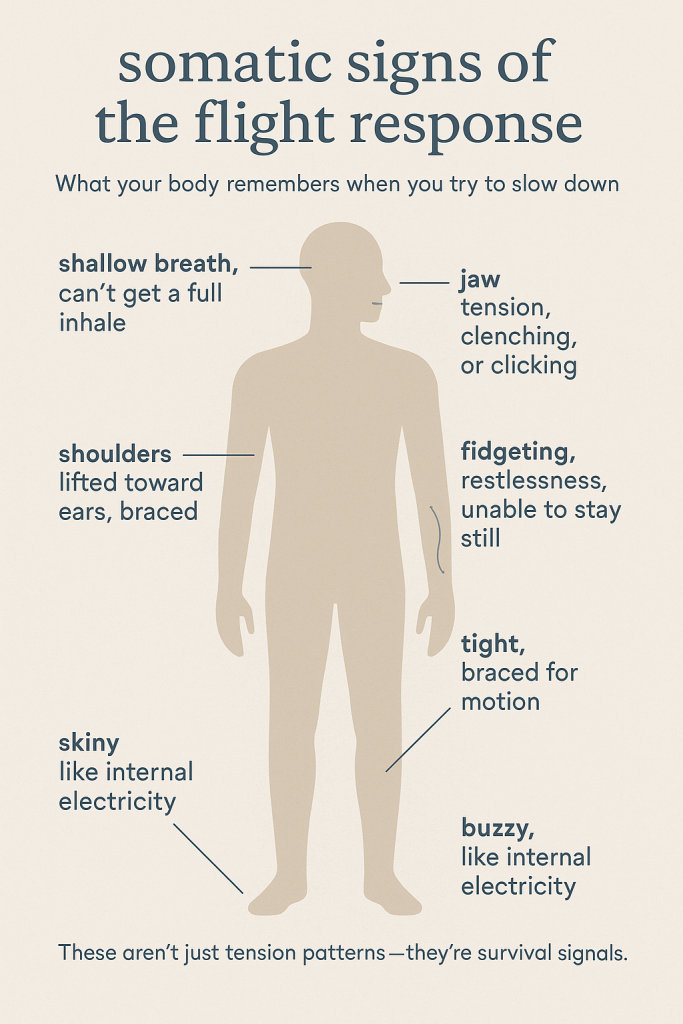
The flight response isn’t just a mental buzz. It’s a full-body experience. You may not call it trauma. You just know something feels… off.
This is where somatic signs of trauma begin to speak—before your mind catches on.
Your breath stays shallow, tight in your chest. You sigh a lot, but it doesn’t feel relieving. Or you catch yourself holding your breath—mid-email, mid-scroll, mid-thought.
Your calves stay braced. Your jaw clicks or clenches. Your shoulders? Halfway to your ears again. This isn’t just tension. These are physiological signs of trauma—your body’s way of staying ready to move.
Even when you’re exhausted, your system hums. A kind of background buzz, like there’s electricity under your skin. Sitting still feels like being trapped. Resting feels like holding your breath underwater.
You multitask, not out of choice—but compulsion. One tab open becomes ten. One task becomes three. You adjust your posture every minute. Fidget, shift, scroll, check. It’s not just distraction. It’s your nervous system dysregulation asking, “Are we still safe?”
Inside, there’s a low-grade panic without a name. An urgency without a deadline. A discomfort with silence that feels louder than noise.
These aren’t flaws. They’re adaptations—your somatic trauma response rehearsing survival.
Often, this gets mislabeled. Anxiety. ADHD. Restlessness. But underneath those names is a mobilized system—doing exactly what it was wired to do when safety feels distant.
Understanding what the flight response feels like lets you meet your body with curiosity instead of shame. Because when you recognize the cues, you can start learning what they need.
How to Begin Healing the Flight Response
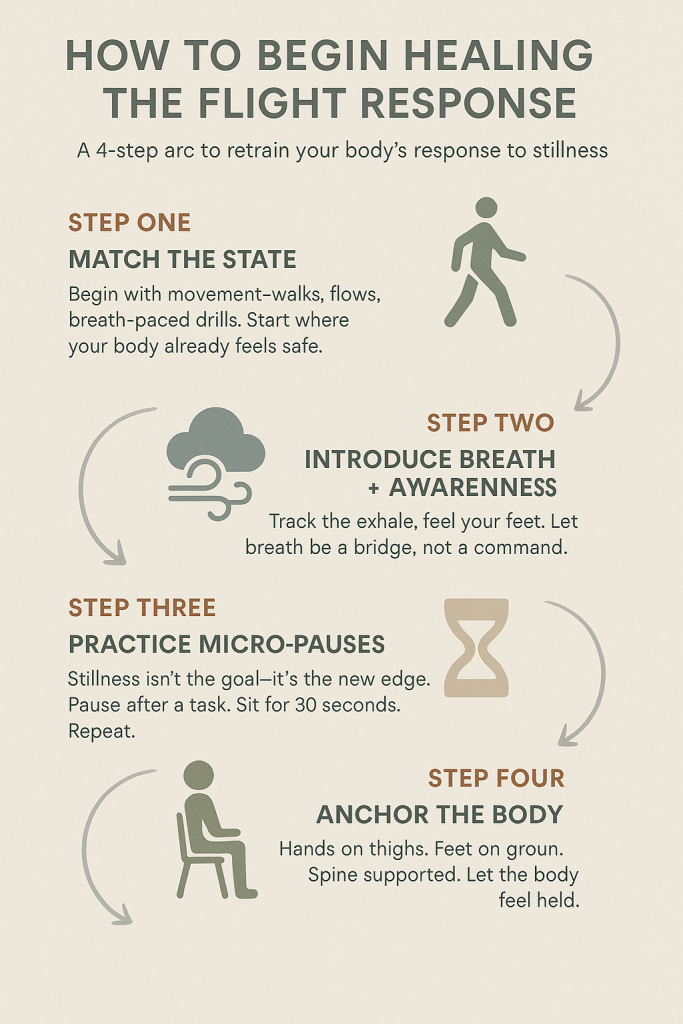
Healing doesn’t start by forcing stillness. It begins by meeting your body where it already is—moving.
To unwind the flight response, we don’t shut down urgency. We meet it with rhythm. With breath. With chosen motion.
Because the truth is: You can move without fleeing. You can pause without collapsing.
This is body-based trauma healing. Not by overriding your impulses, but by retraining your system—slowly, gently, from within.
Step One: Match the State
Start with movement that feels nourishing, not performative. Walks with breath pacing. Flows that follow your rhythm. Martial drills with intention, not output. This is rhythmic movement—it speaks the language your nervous system already knows.
Step Two: Introduce Breath and Awareness
Not control. Just tracking. Notice your exhale. Notice your feet. Let your breath be a bridge, not a command.
Step Three: Microdoses of Stillness
Stillness isn’t the reward. It’s the new edge. Begin with seconds. The pause after a task. The beat between reps. The moment after the sigh.
This is repatterning the trauma response—not with stillness as a test, but as an invitation.
Step Four: Anchor the Body
Use what’s already here. Your hands on your thighs. Your feet on the ground. Your spine supported. These are body anchors that help your system feel held—without needing words.
And in those moments, notice the signs: The warmth behind your eyes. A soft jaw.
The quiet sigh that slips out. These are somatic cues of safety. And they matter more than metrics.
Reframing the Goal
You’re not chasing calm. You’re building capacity.
This isn’t about winning at rest. It’s about becoming someone whose body trusts that rest won’t lead to rupture.
This is how to begin healing the flight response—not with force, but with fluency. Not by changing who you are, but by reminding your body it’s safe to be here.
Mini Exposure Practices for Flight Response Healing
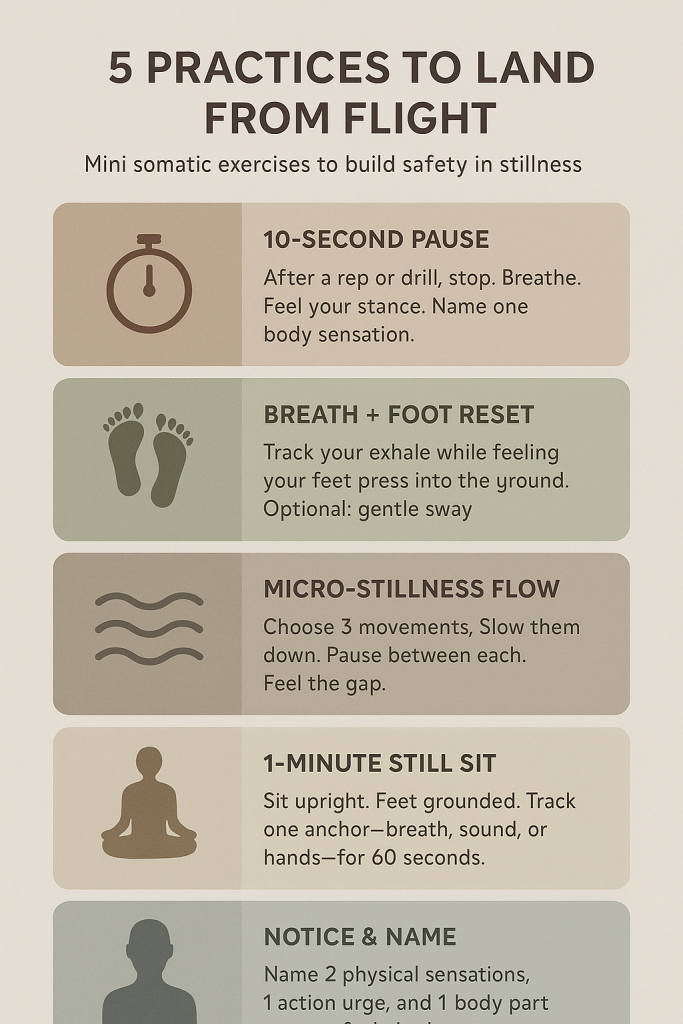
Stillness isn’t easy when your body equates it with danger. But healing the flight response means learning to pause—without panic.
These mini exposure therapy exercises are not about forcing calm. They’re about training your system to tolerate stillness in small, safe doses.
Think of them as nervous system strength training. Just enough discomfort to stretch your capacity—without tipping you into overwhelm.
1. The 10-Second Pause
When: After a movement rep, drill, task, or during a break
What to Do:
- Stop.
- Stand still.
- Breathe.
- Notice one sensation in your body.
Why it works: It teaches your system: “It’s safe to stop.”
2. Breath + Foot Contact Reset
When: Anytime you feel buzzy or disconnected
What to Do:
- While seated or standing, track your exhale.
- Feel your feet pressing into the ground.
- Optional: gently shift your weight side to side.
Why it works: This blends grounding with movement—ideal for somatic healing practices that meet urgency without resistance.
3. Micro-Stillness Flow Drill
When: Mid or post-movement practice
What to Do:
- Choose 3 familiar movements (martial or somatic).
- Perform at half speed.
- Pause for 2–3 seconds between each one.
Why it works: This is a body-based exposure therapy technique that helps rhythm and pause co-exist.
4. 1-Minute Still Sit (Anchored)
When: As a daily rep or end-of-session ritual
What to Do:
- Sit upright, feet flat, hands resting on thighs.
- Pick one anchor (breath, sound, or feet).
- Track it for 60 seconds.
Why it works: It gives the system a low-stakes way to practice presence without needing performance.
5. Notice & Name
When: Any moment of restlessness
What to Do:
- Name 2 physical sensations
- Name 1 internal urge
- Name 1 part of your body you can feel clearly
Why it works: This is a trauma response healing exercise that builds awareness without overload.
This isn’t about fixing flight. It’s about learning stillness—safely. These aren’t tests. They’re reps. And over time, those reps build capacity. Not through intensity, but through presence.
One Client’s Story: Learning to Stop Without Crashing
Jason was the kind of client who “looked fine.” He ran a creative studio, trained six days a week, and could outwork most people around him. But inside? He was exhausted, wired, and quietly panicking anytime life slowed down.
Rest made him anxious. Stillness felt like failure. And even when his body screamed for pause, his mind called it laziness.
He’d done the work—therapy, mindset coaching, breathwork. But none of it stuck. Because his nervous system didn’t feel safe doing nothing.
This is a healing flight response example—where the issue wasn’t knowledge, but capacity.
Jason wasn’t undisciplined. He was in high-functioning flight mode—trapped in movement because stopping felt dangerous.
What Changed?
We didn’t ask him to “just relax.” We started with movement—his comfort zone—but made it rhythmic, intentional, breath-paced.
Between drills, we added 10-second pauses. Simple. Structured. Repeatable.
We introduced stillness not as a goal—but as a rep. He learned to sit for 60 seconds, feet grounded, hands resting, breath tracked.
And slowly, his nervous system recovery story began to unfold.
Rest stopped feeling like collapse. Stillness became a skill—not an indulgence. The pauses weren’t empty anymore. They were anchors.
Jason’s journey is a client case study in trauma healing—not because he reached perfection, but because he practiced safety, again and again.
“I thought I just needed more discipline. Turns out, I needed to learn how to stop without crashing.”
Leave a Reply