Understanding the Fawn Response as a Trauma-Based Survival Strategy

You always say yes. You make sure everyone’s comfortable. You avoid conflict like the plague. But underneath it all, you’re anxious, exhausted, and afraid of letting anyone down. That’s not just being “nice” — that may be the fawn response in action.
The fawn response is one of four trauma response types — alongside fight, flight, and freeze. These aren’t personality traits or choices. They’re automatic nervous system survival responses to perceived emotional danger.
Fawning is the least recognized of the four. It often hides in plain sight — as people-pleasing, conflict avoidance, or self-sacrifice. On the outside, it may look like empathy or emotional maturity. On the inside, it’s anxiety: a body trying to stay safe by keeping others happy.
This response is formed early — often in environments where love felt conditional or conflict meant emotional withdrawal. Over time, the nervous system learns: “If I appease, I’ll be okay.” It’s not a strategy of logic — it’s a pattern rooted in survival.
The fawn response is often misunderstood — it’s not about kindness; it’s about survival. And while it may have protected you once, it doesn’t have to define you now.
What Is the Fawn Response?
The fawn response is a trauma-based survival strategy where your body learns to maintain safety by prioritizing others’ comfort — often at the expense of your own needs, boundaries, and voice.
This is not about kindness. It’s about survival.
When the nervous system perceives emotional threat — like conflict, criticism, or abandonment — it may choose appeasement as the safest path. The fawning trauma response emerges as people-pleasing, conflict avoidance, self-erasure, and chronic agreeableness — all common signs of people pleasing and anxiety. Outwardly, it can look like emotional intelligence. Inwardly, it’s often anxiety and fear in disguise.
“The fawn response is the nervous system’s way of saying: ‘If I keep you calm and happy, I’ll stay safe.’”
Fawning is commonly mistaken for empathy or maturity — but it’s not the same. While empathy is rooted in self-awareness and mutual care, fawning is fear-based. It’s an unconscious pattern driven by a body trying to avoid harm, not connect freely.
At its core, this is a nervous system trauma response, often shaped by early experiences of unpredictability or emotional invalidation. It isn’t a decision — it’s a deeply embedded adaptation.
Recognizing this pattern is the first step toward reclaiming safety and self-trust. The fawn response may have helped you survive — but it doesn’t have to lead the way forever.
Why the Fawning Trauma Response Happens
Rooted in Trauma and Nervous System Dysregulation
The fawning trauma response develops in environments where emotional safety is unpredictable — not always through overt abuse, but often through subtle, chronic instability.
When a child is punished for expressing needs, made responsible for others’ feelings, or only shown love when they’re helpful or quiet, the nervous system adapts. It learns:
“If I soothe, serve, or silence myself — I’ll avoid pain.”
In these cases, fight or flight might not feel safe or possible. The body chooses a different strategy. The amygdala still detects threat, but instead of running or resisting, the nervous system opts for appeasement. Submission becomes the safest way to maintain connection.
This is a nervous system trauma response — not a choice or character flaw. The ventral vagal system, responsible for connection, can activate under fear — not just safety. What looks like helpfulness or calm may actually be the body trying to survive.
Fawning often becomes automatic. A person may not realize they’re doing it. Saying yes when they want to say no. Smiling when they feel afraid. Over-functioning in relationships. Softening truth, shrinking needs. It’s not deception — it’s the body protecting itself.
“This isn’t manipulation. It’s survival through self-erasure.”
This pattern is especially common in “nice” families that avoid conflict, in homes with emotional enmeshment — where boundaries between self and others are blurred — or in cultures where obedience and helpfulness are equated with worth. These dynamics often lead to people pleasing trauma — where care for others overrides care for self.
While trauma response types like fight or flight are often visible, fawning hides in plain sight. It’s often praised as maturity, when in fact, it’s a nervous system shaped by fear.
It’s a nervous system trauma response — not a decision, and not a flaw. And recognizing it is the first step to healing.
Signs of the Fawn Response
Internal and External Symptoms of Fawning

The fawn response can show up in ways that are often mistaken for kindness, helpfulness, or maturity — but are rooted in anxiety and fear.
Fawning isn’t about being nice. It’s a survival strategy — one the nervous system develops to maintain emotional safety through appeasement.
“These signs aren’t just social habits — they’re how the body tries to stay safe through appeasement.”
To recognize it in yourself or someone else, look for these internal experiences and external behaviors:
🧠 Internal Symptoms:
- Persistent guilt or anxiety after saying no
- Fear of being disliked, rejected, or abandoned
- Trouble identifying your own needs, preferences, or feelings
- Feeling invisible, resentful, or emotionally overextended
- Emotional numbness or dissociation after conflict or criticism
🧍 External Behaviors:
- Over-apologizing — even for things beyond your control
- Saying yes reflexively, even when overwhelmed
- Avoiding disagreement, feedback, or criticism
- Smiling or agreeing outwardly while feeling discomfort inside
- Taking responsibility for others’ feelings or stress
- Caretaking or “fixing” — especially when others haven’t asked for it — as your default mode in relationships
These symptoms of fawning trauma response can be hard to spot — especially because many are socially rewarded. Being helpful, agreeable, or emotionally attuned is often seen as strength. But when these behaviors are driven by fear or a need to avoid conflict, they may be signs of people pleasing and anxiety, not true connection.
“Do you ever feel more comfortable pleasing others than stating your own needs? Do you feel anxious when someone’s upset with you — even if you’ve done nothing wrong?”
These patterns don’t mean you’re weak. They mean your body learned to protect you by blending in, pleasing others, and minimizing your own presence. And while the fawn response may have helped you survive before, it’s not the only way to feel safe now.
Recognizing these signs is the first step. Healing begins with reconnecting to your needs — and your nervous system.
Fawning vs. Empathy: A Survival vs. Connection Table
Comparing Survival Behavior to Healthy Empathy
The fawning trauma response is not empathy — it’s a nervous system strategy for safety, not connection.
At first glance, fawning may look like kindness, compassion, or emotional intelligence. It’s often praised, encouraged, and rewarded — especially in environments where conflict is avoided and helpfulness is equated with worth. But underneath fawning is fear. The impulse isn’t to connect; it’s to prevent rejection, conflict, or abandonment.
By contrast, healthy empathy is rooted in safety, boundaries, and mutual care. It includes you, not just the other person. And it isn’t afraid of discomfort.
Here’s how to tell the difference:
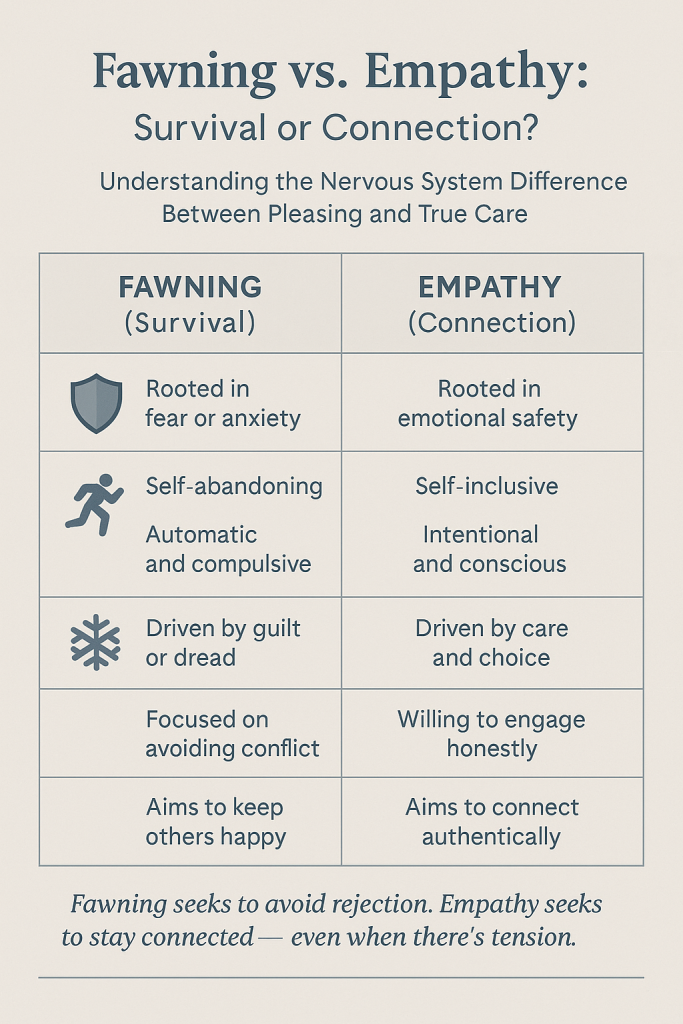
“Fawning seeks to avoid rejection. Empathy seeks to stay connected — even when there’s tension.”
This confusion is common — especially among those who’ve spent years in people pleasing and anxiety patterns. Fawning often begins as a survival tactic in childhood, becoming a reflex over time. But empathy, in its truest form, requires boundaries, clarity, and courage. It includes the ability to say no, to speak truthfully, and to care without losing yourself in the process.
“The fawning trauma response is not empathy — it’s a trauma coping strategy, not a sign of emotional health.”
When you begin to recognize the difference, you can begin shifting from survival strategies to more grounded, connected ways of relating — rooted in safety, truth, and choice.
Why the Fawning Response Often Goes Unnoticed
Socially Rewarded but Nervously Driven
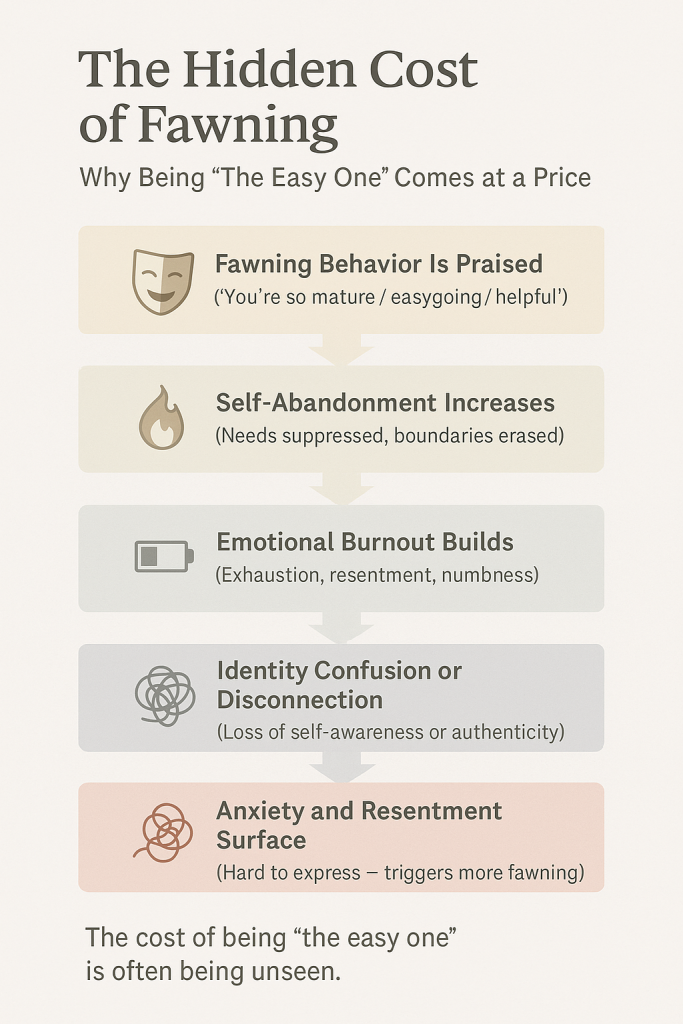
Fawning is often invisible — not because it’s subtle, but because it’s praised.
People with a fawning trauma response are frequently described as:
- “So mature for their age”
- “Easygoing”
- “The peacemaker”
- “The one everyone counts on”
These labels are socially rewarding — but they mask a deeper truth. The behavior they applaud isn’t always about calmness or care. It’s about survival.
“Fawning is often mistaken for emotional intelligence — when it’s actually emotional over-responsibility.”
Fawning looks like empathy, helpfulness, or emotional strength. But it’s driven by people pleasing and anxiety, not genuine connection. It’s a nervous system pattern — a nervous system trauma response — formed in environments where disagreement, needs, or emotional honesty felt unsafe.
Often, the person fawning doesn’t even realize they’re doing it. It’s automatic. A reflex. Say yes. Smile. Stay agreeable. Keep others happy, no matter the cost.
This unconscious habit is especially reinforced in environments like:
- Families where children become emotional caregivers (parentified children)
- Cultures that equate obedience with virtue
- Workplaces where quiet compliance is seen as professionalism
- Gender norms that celebrate self-sacrifice over self-expression
In these systems, people pleasing trauma becomes invisible — because it looks like success.
But under the surface, fawning takes a toll. It leads to emotional burnout, identity confusion, and chronic suppression of needs. It’s rarely questioned until resentment builds or exhaustion takes over.
The cost of being “the easy one” is often being unseen.
Recognizing the nervous system behind your people-pleasing is not about blame — it’s about reclaiming your right to take up space, set boundaries, and relate from safety instead of survival.
How to Heal from the Fawn Response
Somatic Tools to Rewire Your Survival Pattern

Healing the fawn response isn’t about forcing change — it’s about helping your nervous system feel safe enough to choose differently.
This healing isn’t a mindset shift. It’s a body-first process. The fawn response is a nervous system adaptation — a survival pattern wired in response to emotional threat. You don’t “break” this pattern. You retrain it by creating felt experiences of safety, voice, and self-trust.
“You don’t think your way out of fawning — you feel your way to safety.”
These somatic healing tools aren’t quick fixes, but body-based practices that gently rewire your response to relational stress:
1. Breathwork for Regulation
Use long, slow exhales to activate your parasympathetic nervous system — the part of your body that signals “I’m safe now.”
Practice pausing to breathe when you feel the urge to appease, agree, or smooth things over. Breath becomes an interrupt signal. You teach your body: “I can pause. I can stay with myself. I don’t have to rush toward approval.”
2. Voice Practice for Boundaries
Start small by rehearsing simple phrases — even silently or privately:
- “Let me think about that.”
- “That doesn’t work for me right now.”
- “I see it differently.”
These aren’t just scripts. They’re nervous system rehearsals that reverse trauma coping patterns like vocal suppression and emotional shrinking. As you speak, notice the sensations in your body — tension, release, fear, pride. All of it is data, not danger.
3. Micro-Boundaries as Safety Rehearsals
Boundaries don’t have to be big or dramatic. Try tiny, intentional acts that signal safety without submission:
- Waiting before responding to a message
- Saying “not today” to a small favor
- Letting someone misunderstand you without fixing it
These moments help your body practice: “It’s okay to be misunderstood. It’s safe to be separate.”
“You’re not broken. You’re adapting.”
Fawning helped you survive when connection felt conditional. But now, your nervous system can learn something new:
“The same nervous system that helped you survive can now learn what it feels like to be safe — without self-abandonment.”
Go slow. One breath, one pause, one choice at a time. This is the path of healing the fawn response — not through force or willpower, but through embodied safety, breath by breath.
The Fawn Response Can Be Unlearned: You Are Not Broken
The fawn response helped you survive. But it doesn’t have to lead anymore.
What looks like people-pleasing or passivity is often a nervous system trauma response — a pattern your body learned to protect you in environments where safety, boundaries, or emotional honesty felt risky. That wasn’t weakness. That was wisdom.
And healing the fawn response isn’t about forcing yourself to be different. It’s about gently showing your body that safety, voice, and truth are possible now.
“You are not broken — you are adapting.”
Your nervous system — like all trauma response types — can learn. With breath, with pause, with practice, you can move from:
- Hyper-attunement → self-inclusion
- Pleasing → boundaries
- Anxiety → regulation
“The same nervous system that helped you survive can now learn what it feels like to be safe — without self-abandonment.”
This isn’t about fixing yourself. It’s about coming home to yourself.
Ask gently:
- Can I honor how this pattern protected me?
- Can I begin to imagine a relationship where I don’t have to disappear?
Each moment of breath, each truth spoken kindly, each boundary held softly — they’re not just behaviors. They’re evidence that healing the fawn response is already in motion.
You are not starting from scratch. You’re starting from strength.
Leave a Reply