• Skip to primary navigation
  • Skip to main content

ReGroove Fitness

by Wellness Coach Dan Ma

  • Somatic Performance
    • Martial Movement
    • Skill-Based Exercise
  • Wellness Program
  • About
  • Location
  • Testimonials

Uncategorized

Understanding the “Fight” Response in the Fight-or-Flight System

May 10, 2025 by Dan Ma Leave a Comment

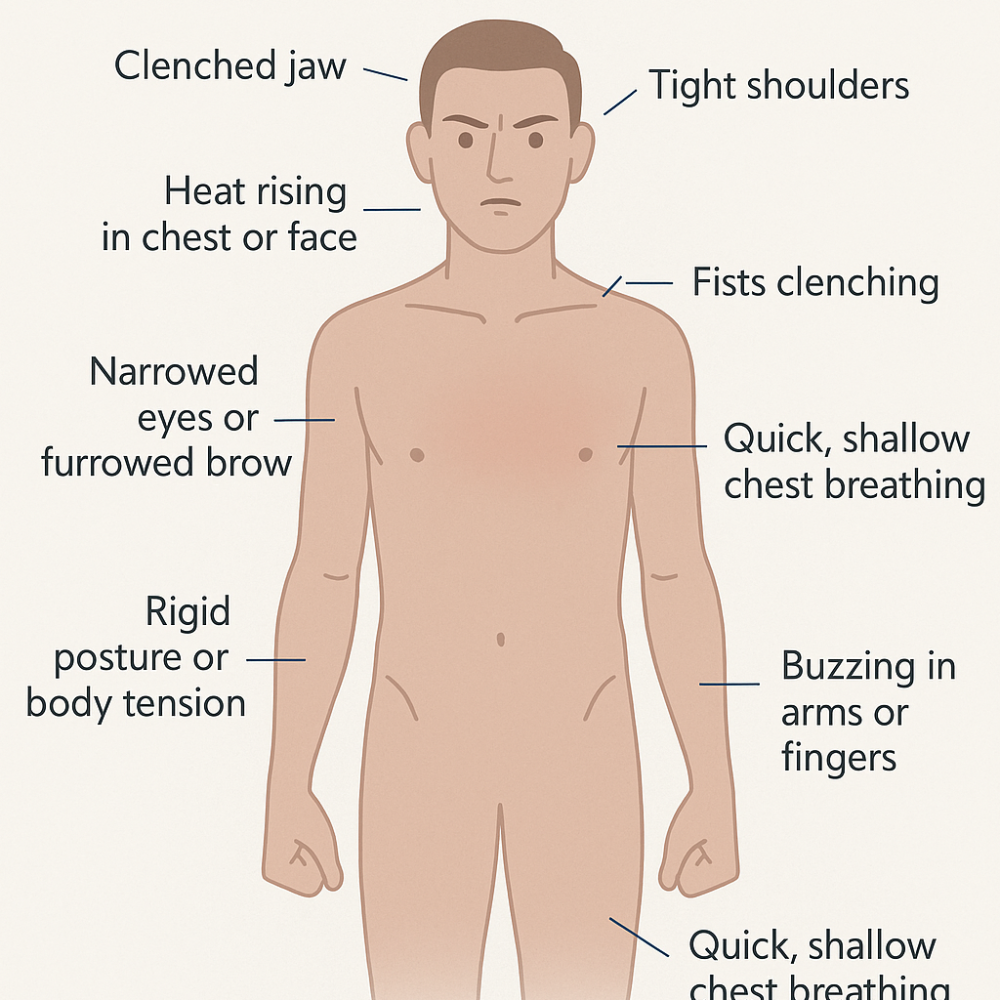
Somatic Signs of the Fight Response

This article is part of our trauma response series. If you’re looking for insights on Flight, Freeze, or Fawn, you can explore those responses as they are linked out.

You don’t choose it. It chooses you. That flash of anger, that sharp edge in your voice, that sudden surge that says “don’t mess with me” — that’s not you being difficult. That’s your nervous system stepping in to protect you. The fight response is one branch of the fight-or-flight survival system, a fast, automatic process directed by your autonomic nervous system. When your body perceives threat — even if it’s emotional, relational, or subtle — the sympathetic nervous system activates. Blood moves to your muscles, adrenaline spikes, and your body prepares to either confront or escape the danger.

But for people with trauma histories, the alarm system can be oversensitive. Ordinary stressors — a boundary crossed, a shift in tone, a flash of criticism — can feel like danger. And in those moments, the fight response activates before you have time to think. This isn’t about having a “bad temper.” It’s a trauma response — your body trying to keep you safe. It’s not personal. It’s primal.

Somatic Signs of the Fight Response: heat rising in the chest or face, clenched jaw or fists, tight shoulders, buzzing energy, urge to lash out, interrupt, or control, difficulty softening or listening.

If you’ve ever asked yourself, “Why do I get so angry so fast?” — you’re not alone. And you’re not broken. Your body remembers what it needed to survive. Sometimes, fight was the only way. Let’s take a closer look at what that fight response really is — how it shows up, and what it’s protecting.

What Is the Fight Response in Trauma?

The fight trauma response isn’t about being mean, difficult, or controlling. It’s about survival. At its core, this reaction says: “I must defend myself to survive.” That’s not drama — that’s biology. When the sympathetic nervous system senses a threat, it mobilizes your body to fight. Muscles tighten. Blood pressure rises. Your focus narrows. This is your system preparing to confront danger. But in trauma survivors, that danger signal doesn’t always turn off. The body keeps reacting — not just to physical threats, but to emotional ones. A dismissive tone, a missed call, a broken promise — all can trigger the same internal alarm.

When boundaries weren’t respected or no one stepped in to protect you, your nervous system may have learned to protect itself through force. That protection can look like yelling, arguing, or needing to control the situation. It can also live inside you: as perfectionism, harsh self-criticism, or the constant need to “fix” things. What feels like “too much anger” is often a response to past powerlessness. It’s grief without a name. It’s fear in armor. It’s your body refusing to be ignored again.

You may find yourself asking: “Why do I feel like I’m always on edge?” “Why do I snap when I feel unheard?” “Why can’t I just let things go?” These aren’t signs of emotional failure. They’re signs of a trauma response doing its best to keep you safe — even when the danger is long gone.

Common signs of the fight response include explosive anger, irritability, the urge to correct or argue, and feeling like you must defend your worth at every turn. Internally, it can look like being hard on yourself, never feeling good enough, or needing everything in your environment to stay in control.

This isn’t dysfunction. It’s protection. And it makes sense.

Next, we’ll explore how this protective state shows up in your body — the somatic signals of being in fight mode, and what they’re trying to tell you.

Somatic Signs of the Fight Trauma Response

Somatic Signs of the Fight Response

Sometimes the mind doesn’t know what the body already does. When you’re in fight mode, it might not feel like a trauma response. It might feel like urgency. Like needing to be right. Like something in the room just isn’t safe — even if nothing’s actually happening.

This is how trauma and the nervous system often speak: not through thoughts, but through sensations. Your body-based trauma response is trying to tell you something.

Recognizing fight mode often starts here — not with your beliefs, but with what’s happening in your muscles, breath, and posture.

Physical symptoms of the fight response may include: heat rising in the chest or face, jaw clenching or grinding teeth, fists tightening, buzzing in the arms, tension through the shoulders, quick, shallow chest breathing, narrowed eyes, furrowed brow, or an urge to dominate a conversation or space.

For some, the reaction is loud — snapping, yelling, speaking over others. For others, it’s silent — stiff posture, locked jaw, internal rage held behind the eyes. Both are forms of nervous system dysregulation. Both are ways the body says: “I don’t feel safe.”

You might notice thoughts like: “Why am I so on edge?” “Why do I explode over nothing?” “Why can’t I calm down?” That’s not weakness. That’s your trauma body response asking for support — not judgment.

These aren’t signs that you’re “too much.” They’re signs that your nervous system learned to be ready — all the time.

Next, let’s explore why the fight response is so often misunderstood — and how that misunderstanding adds to the shame.

Why the Fight Response Is Often Misunderstood

How the Fight Response Feels vs. How It’s Misunderstood

You were never too much. You were misread.

For many trauma survivors, the fight response is the most punished — and the least understood. Especially if you were socialized to be “nice,” raised to keep the peace, or learned to please before you could protect yourself.

When your nervous system enters fight mode, it’s not trying to hurt anyone. It’s trying to protect you. But the world often doesn’t see that. What it sees is yelling, sharpness, control — and it calls it aggression.

This is how the fight response gets misinterpreted. You may have been labeled bossy, oppositional, dramatic, intense. Maybe you apologized for “overreacting,” but no one ever showed you what emotional dysregulation actually meant — or how to feel safe in your body.

What people rarely understand is that fight doesn’t always explode. It can compress. It can look like perfectionism, clenched jaws, or silent tension. It can be the need to plan everything, fix everything, hold everything together — even when you’re breaking.

Over time, these labels become internalized. You begin to wonder: “Why can’t I be calm?” “Why do I always ruin things?” “Why am I too much for everyone?” This is internalized shame — a trauma response in its own right.

Reframing trauma reactivity begins here: by seeing that your anger isn’t a flaw. It’s a form of protection. That boundary you tried to set with your voice? That wasn’t too loud. It was too long ignored.

This is the heartbreak of a misunderstood trauma response — when your body’s attempt to protect you is what gets rejected.

Let’s look underneath the surface now — into what the fight response is really guarding.

What the Fight Response Is Really Protecting

What the Fight Response Is Really Protecting

The fight response isn’t about dominance. It’s about defense. Often, what looks like control on the outside is really fear on the inside. Powerlessness wearing armor. Anger standing in for grief.

When you’ve lived through trauma — especially without protection — your nervous system may have learned that the only way to stay safe is to stay strong. If no one stood up for you, your body decided it had to do it alone. That’s not dysfunction. That’s survival.

This is the nervous system’s logic: If I stay big, no one can make me feel small again. If I stay sharp, no one can catch me off guard. If I’m always ready to fight, I won’t feel helpless like I did before.

Many people who live in fight mode carry these silent beliefs:

  • “No one will protect me unless I do it myself.”
  • “If I don’t fight back, I’ll disappear.”
  • “I wasn’t allowed to say no — so now I have to scream it.”
  • “I was punished for being angry, but no one noticed I was scared.”

This is what childhood trauma response patterns can look like in adulthood: perfectionism, over-control, the need to win every interaction. Not because you’re power-hungry — but because your inner child trauma response is still trying to feel safe.

This is why trauma can look like control or rage. Not because you’re broken. Because your body is trying to reclaim dignity it was once denied.

Anger, in this context, is a boundary. It’s the nervous system saying: “I exist. I matter. I won’t be erased again.”

So if your reactions feel big, intense, or hard to hold — know this: they come from something tender. Something trying to protect you.

Let’s explore how to meet that part of you with tools — not suppression. We’ll look next at how to work with the fight response in a way that builds trust, not tension.

How to Work with the Fight Response in a Healthy Way

Tools to Work with Fight Energy

The goal isn’t to shut the fight response down. The goal is to build a relationship with it. To understand that the heat, the urgency, the edge — they’re signals from a nervous system doing its best to protect you.

When you meet that energy with tools instead of shame, something shifts. The body begins to trust that it can feel powerful without causing harm. That it can express without exploding.

Here are some ways to begin that conversation.

Somatic discharge for trauma: When your body feels charged, give it somewhere safe to go. Press your hands into a wall. Shake out your limbs. Let your voice rise in a safe space — even if it’s screaming into a towel. Bare feet on the ground or holding something cold can also bring you back into the moment. These are nervous system calming tools, not punishments for being reactive.

Healthy ways to process anger: Try anger journaling — write exactly what your inner protector wants to say without censoring. Move fast: walk with purpose, hit a heavy bag, or let your breath move with intensity and then settle. Use movement to release, not suppress. This is how fight response regulation starts to take root.

Relational regulation: Practice saying, “I need a moment,” when you feel yourself escalating. If a rupture happens, return to it with compassion: “I was in fight mode. I wasn’t trying to hurt you.” Boundaries don’t always have to be reactive. They can be clear, early, and kind.

This is a practice — not a fix. It’s about learning to recognize when the inner fighter is online and giving that part of you a safe outlet. Over time, what once felt overwhelming begins to feel workable.

Next, we’ll explore what healing looks like — how the fight response can evolve from reactivity into wise, embodied boundaries.

Healing the Fight Response: Reclaiming Power and Boundaries

Healing the fight response doesn’t mean becoming softer or quieter. It means becoming more rooted, more discerning, more yourself. This isn’t about silencing anger — it’s about understanding what it’s protecting, and learning how to channel it with intention.

Many people fear their own strength because it’s only ever shown up in moments of rupture. But when you heal the fight response, that same energy becomes a boundary, not a blade.

This is what healthy expressions of fight energy can look like: Saying no without flinching or apologizing. Speaking truth without needing to overpower. Feeling strong in your body — not because you’re braced, but because you’re present. Letting anger guide your clarity, not control your behavior.

Healing looks like this: Pausing before you react. Choosing how to respond instead of being swept by survival. Trusting that your worth is not on trial every time someone disagrees with you. Building relationships that honor directness and safety. Knowing that your nervous system doesn’t have to go into defense to feel protected.

This is trauma-informed empowerment. It’s what happens when your body learns that power doesn’t have to be a reaction — it can be a resource.

This is how trauma impacts self-protection: it wires us to fight or collapse. But healing rewires us to stand — with strength, with clarity, with compassion.

When anger is integrated, it becomes a compass. When the fight response is regulated, it becomes a protector you can trust.

Let’s close by remembering this: the fight response is not a flaw. It’s a survival strategy — one you can learn to work with, not against.

Conclusion: The Fight Response Is Not a Flaw. It’s a Survival Strategy

The fight response is not a character defect. It’s a survival strategy — one that your body chose when choice felt like a luxury. If you’ve lived in fight mode, it’s because something in you remembered that staying silent wasn’t safe. That disappearing was not an option.

Anger, in this light, is not the enemy. It’s a protective part — the one that stepped in when no one else did. The one that raised its voice because your needs had been ignored. The one that defended your worth before you even knew how to name it.

You’re not too much. You were too alone for too long. And that part of you that still clenches, snaps, or surges? It’s just trying to keep you safe. That’s not brokenness. That’s devotion.

Reclaiming the fight response doesn’t mean losing your fire. It means learning how to carry it without getting burned. It means recognizing that you don’t have to prove your power — you already have it. It lives in your breath, your boundaries, your ability to stay present when it’s hard.

This is compassionate trauma recovery — not by silencing your nervous system, but by learning to listen to it with care.

You didn’t choose to live in defense. But now you get to choose how to meet that defender within you.

You can meet it with tools. With patience. With trust.

And when you’re ready, you can keep exploring. The other trauma responses — Flight, Freeze, Fawn — may hold more of your story. Somatic tools and trauma-informed communities may offer places to land.

But for now, one truth might be enough:

“I don’t have to fight to prove I matter. I already do.”
Filed Under: Uncategorized

The Flight Trauma Response: Why You Can’t Slow Down — and How to Finally Land

May 10, 2025 by Dan Ma Leave a Comment

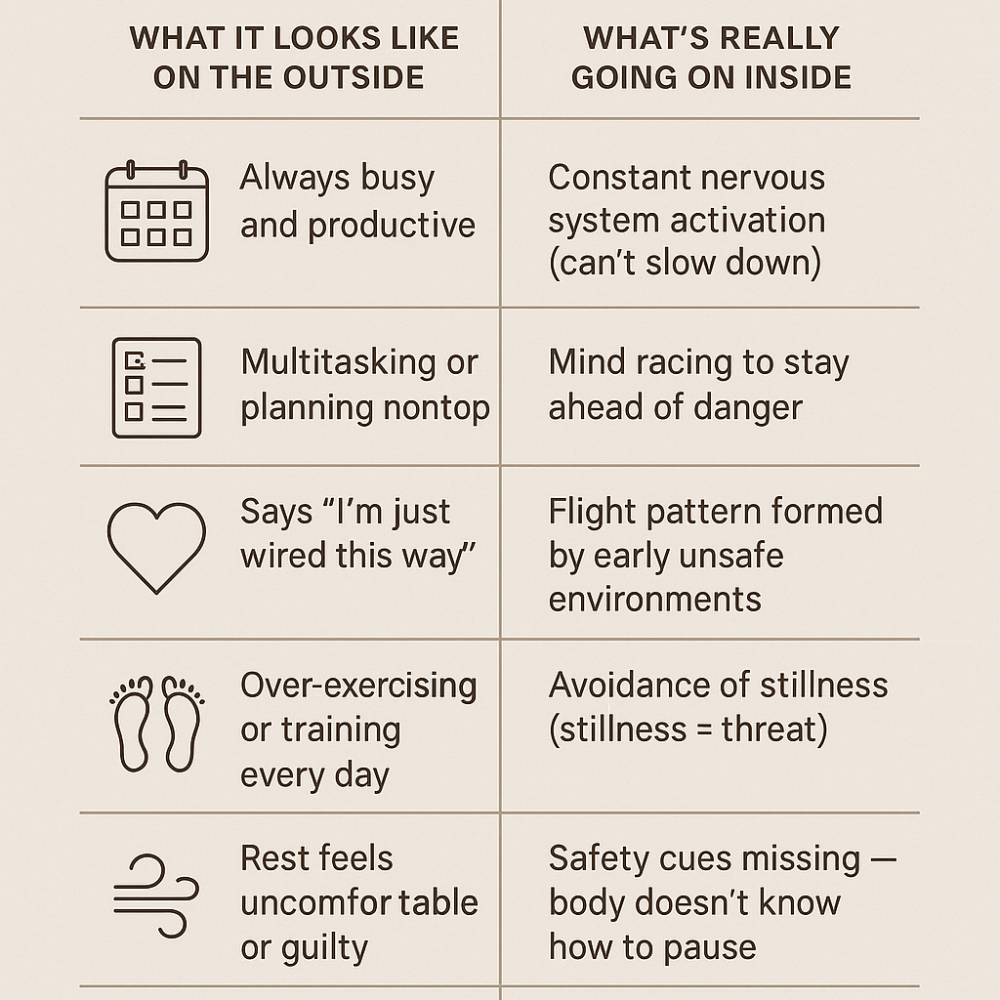
Spot the Flight Response

Where the Flight Response Comes From

You didn’t choose to live in fast-forward. Your body learned to—because it had to.

The flight response doesn’t appear out of nowhere. It’s a pattern, built brick by brick in environments where stillness felt dangerous, and movement felt like safety.

This is survival-based conditioning.

Maybe your house was loud, unpredictable, or silent in the wrong ways. Maybe you became the fixer, the achiever, the emotional buffer. Maybe rest was punished, softness ridiculed, or needs ignored. So your system found a workaround: motion.

Early trauma and the nervous system go hand in hand. Without consistent safety cues—touch, tone, attention—the body stays on alert. This is childhood nervous system development in survival mode.

Attachment plays a role, too. Anxious attachment can wire in a deep fear of stillness. If slowing down meant abandonment or disconnection, then flight becomes the nervous system’s shield.

These are trauma imprints from childhood—not personality traits. And the flight response? It’s a somatic trauma pattern that once kept you safe.

As Polyvagal Theory explains, when the body perceives threat but still has energy, it mobilizes—flight mode. You stay busy, not to thrive, but to avoid collapse.

If your body grew up in a storm, it makes sense that it still wants to keep moving. You learned to ride your nervous system like a bike with no brakes—because it was the only way to stay upright.

This isn’t weakness. It’s brilliance. But now, brilliance can soften into safety.

Where the Flight Response Comes From

Spot the Flight Response

The flight response didn’t just appear one day. It was shaped—by what your body lived through.

This isn’t a flaw in your character. It’s a survival strategy your nervous system learned to rely on.

If your early world felt emotionally unpredictable…
If you had to stay two steps ahead just to feel safe…
If stillness got you in trouble, or rest felt dangerous— then flight likely became your nervous system’s best attempt at protection.

These are the quiet origins—the causes of trauma responses that don’t always look like trauma.

You might have grown up in chaos, where calm never lasted. Or in silence so thick, your body learned to fill the space. Maybe you became the fixer, the achiever, the one who held it all together.

That’s not just personality. It’s an early attachment and trauma imprint. A somatic trauma pattern whispering: “Stay in motion, or it all might fall apart.”

According to Polyvagal Theory, this is what happens when the body loses access to safety. Without co-regulation or stable connection, the nervous system development shifts. The ventral vagal system (calm, connection) goes offline. The sympathetic system (mobilize, flee) steps in.

You didn’t choose flight. Your body did—because it worked.

And attachment matters, too. Anxious or avoidant bonds can train a child to hustle for closeness. To move, manage, or morph to avoid disconnection.

It’s not about being dramatic. It’s about being alive. In the absence of steady safety, your system learned this truth: Movement = survival.

As one client said: “I learned to move like a bike with no brakes—because that’s what kept me upright.” Or: “If your body grew up in a storm, it makes sense that it still wants to keep moving.”

These aren’t just metaphors. They’re memories your body carries.

Understanding the origin of trauma response helps you meet these patterns with compassion. Because when you see where they came from, you can begin to choose where they go.

What It Feels Like in the Body

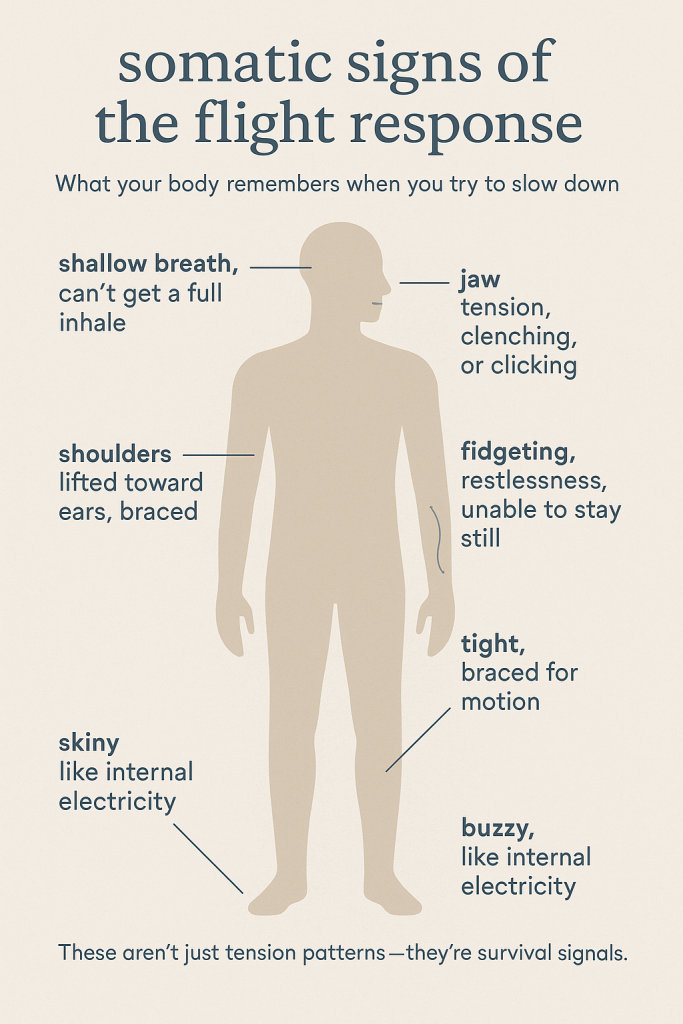
Somatic Signs of the Flight Response

The flight response isn’t just a mental buzz. It’s a full-body experience. You may not call it trauma. You just know something feels… off.

This is where somatic signs of trauma begin to speak—before your mind catches on.

Your breath stays shallow, tight in your chest. You sigh a lot, but it doesn’t feel relieving. Or you catch yourself holding your breath—mid-email, mid-scroll, mid-thought.

Your calves stay braced. Your jaw clicks or clenches. Your shoulders? Halfway to your ears again. This isn’t just tension. These are physiological signs of trauma—your body’s way of staying ready to move.

Even when you’re exhausted, your system hums. A kind of background buzz, like there’s electricity under your skin. Sitting still feels like being trapped. Resting feels like holding your breath underwater.

You multitask, not out of choice—but compulsion. One tab open becomes ten. One task becomes three. You adjust your posture every minute. Fidget, shift, scroll, check. It’s not just distraction. It’s your nervous system dysregulation asking, “Are we still safe?”

Inside, there’s a low-grade panic without a name. An urgency without a deadline. A discomfort with silence that feels louder than noise.

These aren’t flaws. They’re adaptations—your somatic trauma response rehearsing survival.

Often, this gets mislabeled. Anxiety. ADHD. Restlessness. But underneath those names is a mobilized system—doing exactly what it was wired to do when safety feels distant.

Understanding what the flight response feels like lets you meet your body with curiosity instead of shame. Because when you recognize the cues, you can start learning what they need.

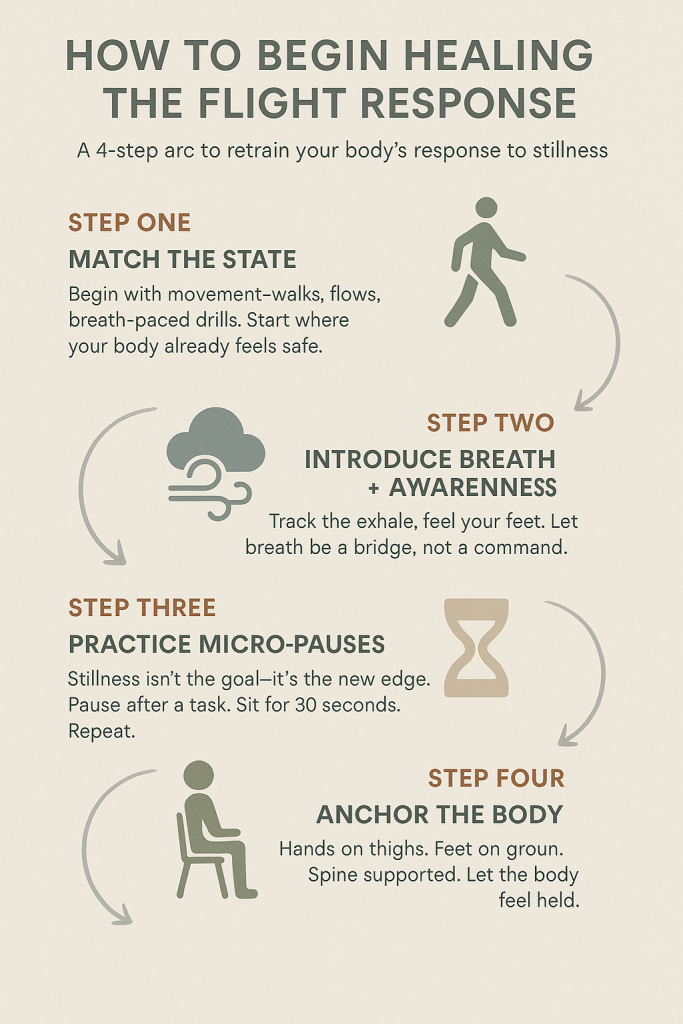
How to Begin Healing the Flight Response

How to Begin Healing the Flight Response

Healing doesn’t start by forcing stillness. It begins by meeting your body where it already is—moving.

To unwind the flight response, we don’t shut down urgency. We meet it with rhythm. With breath. With chosen motion.

Because the truth is: You can move without fleeing. You can pause without collapsing.

This is body-based trauma healing. Not by overriding your impulses, but by retraining your system—slowly, gently, from within.

Step One: Match the State

Start with movement that feels nourishing, not performative. Walks with breath pacing. Flows that follow your rhythm. Martial drills with intention, not output. This is rhythmic movement—it speaks the language your nervous system already knows.

Step Two: Introduce Breath and Awareness

Not control. Just tracking. Notice your exhale. Notice your feet. Let your breath be a bridge, not a command.

Step Three: Microdoses of Stillness

Stillness isn’t the reward. It’s the new edge. Begin with seconds. The pause after a task. The beat between reps. The moment after the sigh.

This is repatterning the trauma response—not with stillness as a test, but as an invitation.

Step Four: Anchor the Body

Use what’s already here. Your hands on your thighs. Your feet on the ground. Your spine supported. These are body anchors that help your system feel held—without needing words.

And in those moments, notice the signs: The warmth behind your eyes. A soft jaw.
The quiet sigh that slips out. These are somatic cues of safety. And they matter more than metrics.

Reframing the Goal

You’re not chasing calm. You’re building capacity.

This isn’t about winning at rest. It’s about becoming someone whose body trusts that rest won’t lead to rupture.

This is how to begin healing the flight response—not with force, but with fluency. Not by changing who you are, but by reminding your body it’s safe to be here.

Mini Exposure Practices for Flight Response Healing

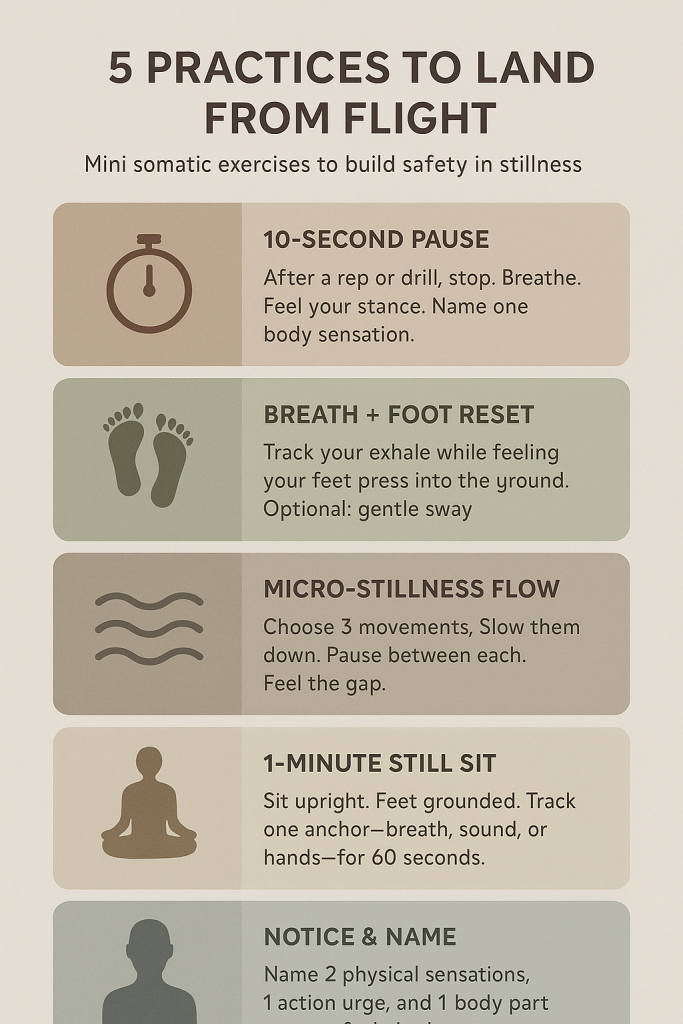
5 Practices to Land from Flight

Stillness isn’t easy when your body equates it with danger. But healing the flight response means learning to pause—without panic.

These mini exposure therapy exercises are not about forcing calm. They’re about training your system to tolerate stillness in small, safe doses.

Think of them as nervous system strength training. Just enough discomfort to stretch your capacity—without tipping you into overwhelm.

1. The 10-Second Pause

When: After a movement rep, drill, task, or during a break
What to Do:

  • Stop.
  • Stand still.
  • Breathe.
  • Notice one sensation in your body.

Why it works: It teaches your system: “It’s safe to stop.”

2. Breath + Foot Contact Reset

When: Anytime you feel buzzy or disconnected
What to Do:

  • While seated or standing, track your exhale.
  • Feel your feet pressing into the ground.
  • Optional: gently shift your weight side to side.

Why it works: This blends grounding with movement—ideal for somatic healing practices that meet urgency without resistance.

3. Micro-Stillness Flow Drill

When: Mid or post-movement practice
What to Do:

  • Choose 3 familiar movements (martial or somatic).
  • Perform at half speed.
  • Pause for 2–3 seconds between each one.

Why it works: This is a body-based exposure therapy technique that helps rhythm and pause co-exist.

4. 1-Minute Still Sit (Anchored)

When: As a daily rep or end-of-session ritual
What to Do:

  • Sit upright, feet flat, hands resting on thighs.
  • Pick one anchor (breath, sound, or feet).
  • Track it for 60 seconds.

Why it works: It gives the system a low-stakes way to practice presence without needing performance.

5. Notice & Name

When: Any moment of restlessness
What to Do:

  • Name 2 physical sensations
  • Name 1 internal urge
  • Name 1 part of your body you can feel clearly

Why it works: This is a trauma response healing exercise that builds awareness without overload.

This isn’t about fixing flight. It’s about learning stillness—safely. These aren’t tests. They’re reps. And over time, those reps build capacity. Not through intensity, but through presence.

One Client’s Story: Learning to Stop Without Crashing

Jason was the kind of client who “looked fine.” He ran a creative studio, trained six days a week, and could outwork most people around him. But inside? He was exhausted, wired, and quietly panicking anytime life slowed down.

Rest made him anxious. Stillness felt like failure. And even when his body screamed for pause, his mind called it laziness.

He’d done the work—therapy, mindset coaching, breathwork. But none of it stuck. Because his nervous system didn’t feel safe doing nothing.

This is a healing flight response example—where the issue wasn’t knowledge, but capacity.

Jason wasn’t undisciplined. He was in high-functioning flight mode—trapped in movement because stopping felt dangerous.

What Changed?

We didn’t ask him to “just relax.” We started with movement—his comfort zone—but made it rhythmic, intentional, breath-paced.

Between drills, we added 10-second pauses. Simple. Structured. Repeatable.

We introduced stillness not as a goal—but as a rep. He learned to sit for 60 seconds, feet grounded, hands resting, breath tracked.

And slowly, his nervous system recovery story began to unfold.

Rest stopped feeling like collapse. Stillness became a skill—not an indulgence. The pauses weren’t empty anymore. They were anchors.

Jason’s journey is a client case study in trauma healing—not because he reached perfection, but because he practiced safety, again and again.

“I thought I just needed more discipline. Turns out, I needed to learn how to stop without crashing.”

Filed Under: Uncategorized

The Freeze Trauma Response: Why You Shut Down — and How to Gently Recover

May 8, 2025 by Dan Ma Leave a Comment

You’re in the car. Engine off, keys in hand. The day is over — but your body isn’t moving. You’re not crying. Not panicking. Just still. Like the signal to go never arrived.

Or you’re halfway through a workout, and suddenly the reps fade. Your breath catches. You’re here — but not really.

Or you’re scrolling in bed, knowing you “should” get up — but your limbs feel like lead.

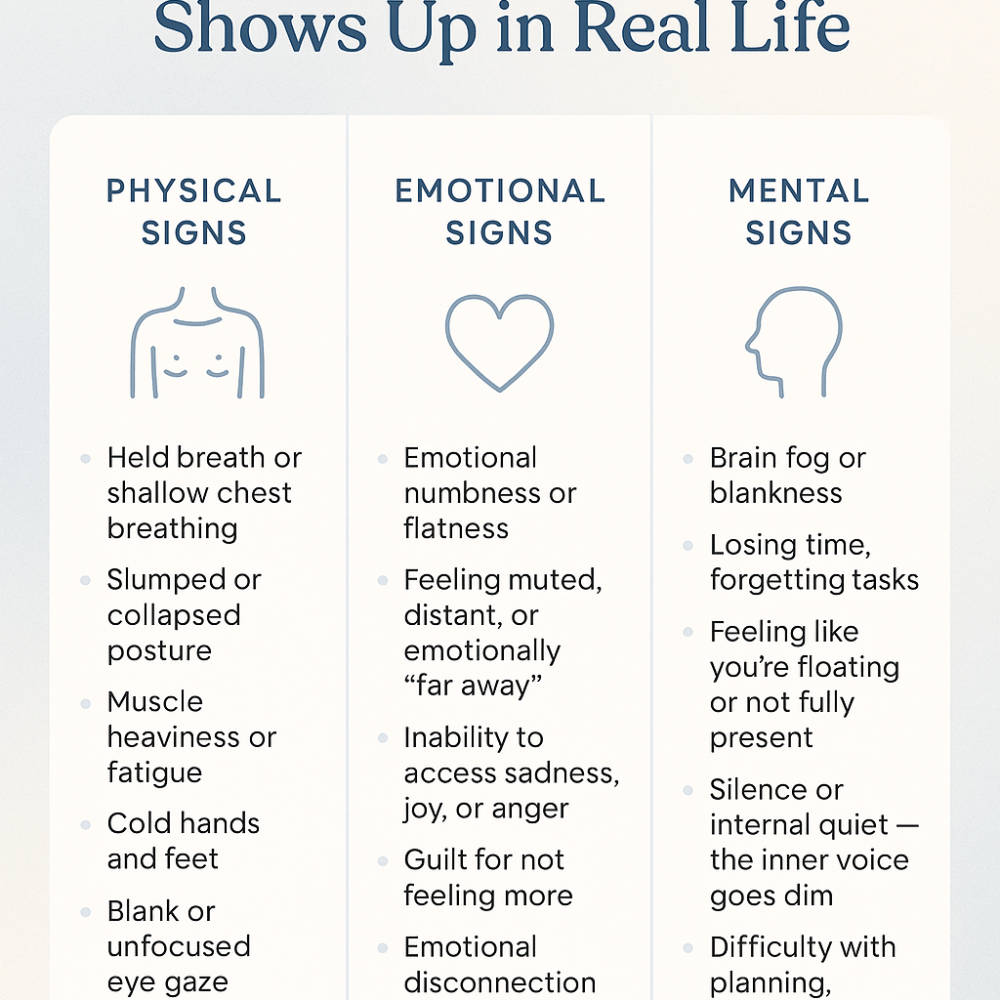
This is the freeze trauma response. Not a flaw. Not laziness. It’s survival — the body’s built-in reflex when fighting or fleeing isn’t an option. It’s your nervous system doing its job: conserving energy, muting sensation, keeping you safe.

If you’ve ever felt numb instead of driven, flat instead of focused — you didn’t fail. Your system protected you.

In this article, we’ll explore what freeze really is, how it forms, and what it takes to gently thaw. Not by pushing through, but by relearning safety — one breath, one step, one moment at a time.

What Is the Freeze Trauma Response?

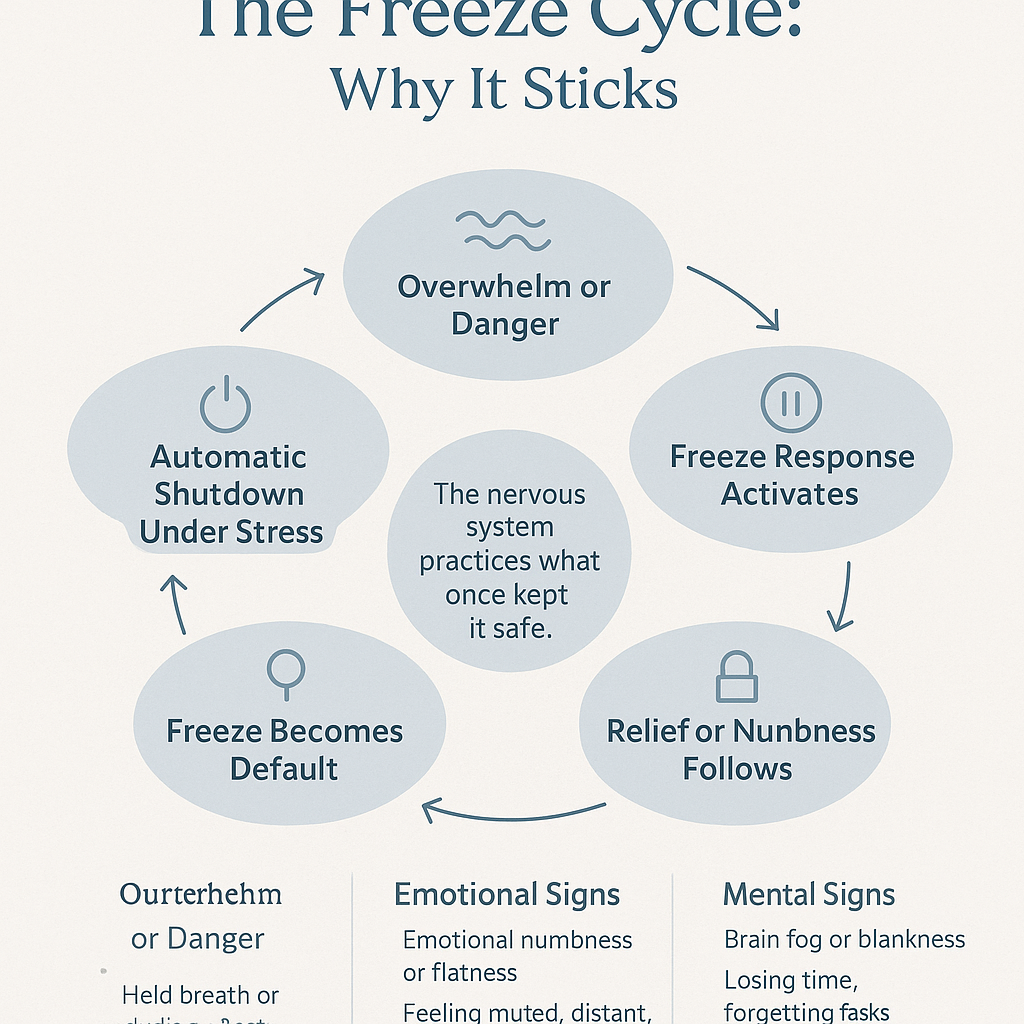
Freeze isn’t a mindset issue. It’s not about motivation or willpower. It’s an ancient, automatic survival response triggered when the body perceives danger — but no safe way out.

Governed by the dorsal branch of the vagus nerve, freeze draws energy inward. Muscles go still. Breath slows or halts. Emotions dim. It’s the nervous system’s version of a system shutdown.

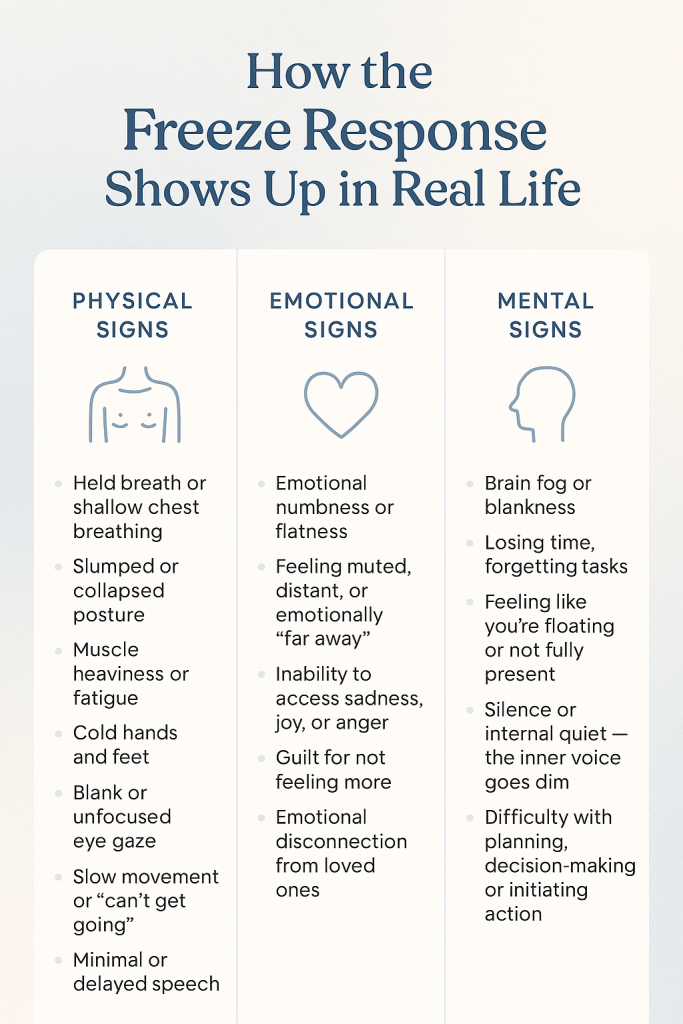
What it might feel like:

  • Heavy limbs, foggy head
  • Flat affect or emotional blankness
  • A sense of being there, but not present

It’s often misread as apathy or calm. But under the stillness is a system working hard to survive.

How the Freeze Response Shows Up in Real Life

Freeze is often invisible — especially in high-functioning people. It shows up in moments like these:

  • Zoning out mid-conversation
  • Sitting in a car unable to move
  • Going blank during a meeting
  • Scrolling endlessly while your to-do list waits

Jason finishes work and can’t send a single email.

“I’m functional all day — then I disappear.”

Rachel parks outside the grocery store but can’t open the door.

“My body is quiet, but I’m screaming inside.”

Eli tries a somatic practice — and goes numb halfway through.

“I shut down in the middle of awareness. Like the light flickered off.”

These aren’t personality flaws. They’re signs of a nervous system trying to stay safe.

Freeze vs. Other Trauma Responses

All trauma responses are survival strategies:

ResponseSystem ModePatternCommon Feelings
FightSympatheticConfront“I get angry or intense.”
FlightSympatheticEscape“I overwork or avoid.”
FawnParasympathetic (ventral)Appease“I say yes to stay safe.”
FreezeParasympathetic (dorsal)Shut down“I go numb or can’t move.”
FlopExtreme dorsal vagalCollapse“I lose control or faint.”

Freeze mimics calm but is inward chaos. Quiet on the outside, overwhelmed inside.

Why Freeze Happens — And Why It Sticks

Freeze kept our ancestors alive. Animals freeze to avoid detection or reduce pain when escape isn’t possible. That same circuitry lives in us.

In humans, freeze can become a default — especially if:

  • Childhood environments lacked safety
  • Emotions weren’t welcomed or mirrored
  • Expression was met with punishment or neglect

Your body learned: “Stillness is safer than feeling.”

Over time, freeze becomes the most practiced — and thus most automatic — response.

Jason grew up in a high-pressure home. He achieves, then crashes.

“If I’m not achieving, I don’t know how to exist.”

Rachel learned to care for others, not herself.

“I vanish when I’m not needed.”

Eli avoided emotional conflict by going numb.

“Freeze feels familiar — even when I don’t want it.”

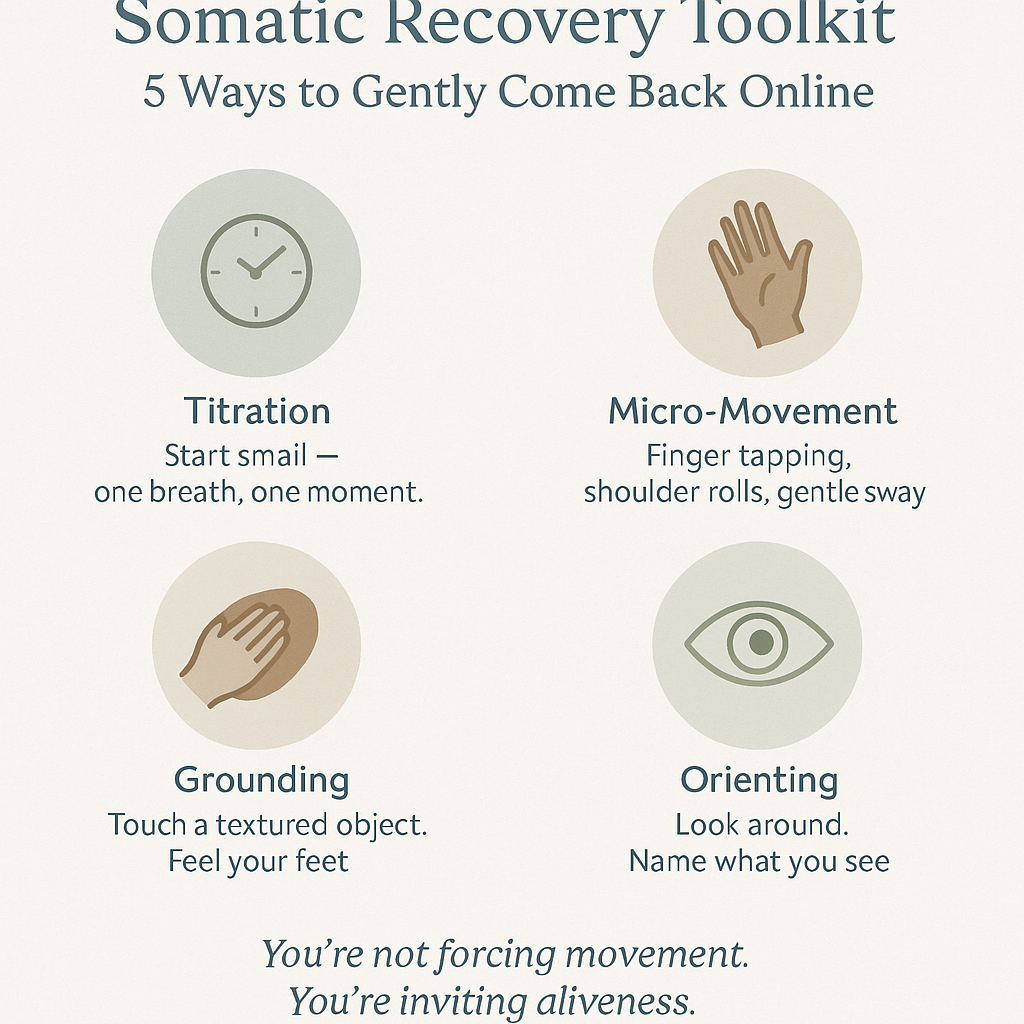
Somatic Recovery: How to Gently Come Back Online

You don’t push through freeze. You thaw out — slowly, with your body leading.

1. Titration

Start with just enough:

  • One breath
  • A five-second stretch
  • Noticing your feet on the ground

“I don’t need to fix it — just feel a little more.”

2. Micro-Movement

Invite subtle shifts:

  • Finger tapping
  • Shoulder rolls
  • Rocking side to side

“You’re not forcing — you’re inviting aliveness.”

3. Grounding

Use sensory cues:

  • Touch a textured object
  • Feel feet in your shoes
  • Track sound or temperature

“Touch brings me back faster than thinking.”

4. Breath

Don’t force breath — soften around it:

  • Inhale 4 / Exhale 6
  • Hand on belly
  • Audible sigh

“It’s like I come back into myself — even just a little.”

5. Orienting

Remind your body you’re not trapped:

  • Turn your head slowly
  • Look at one neutral thing
  • Say: “I see the lamp. I see the door.”

“I can feel myself rebooting — slowly, but it’s real.”

Freeze isn’t melted by willpower. It’s thawed by care, rhythm, and body-based healing — one moment at a time.

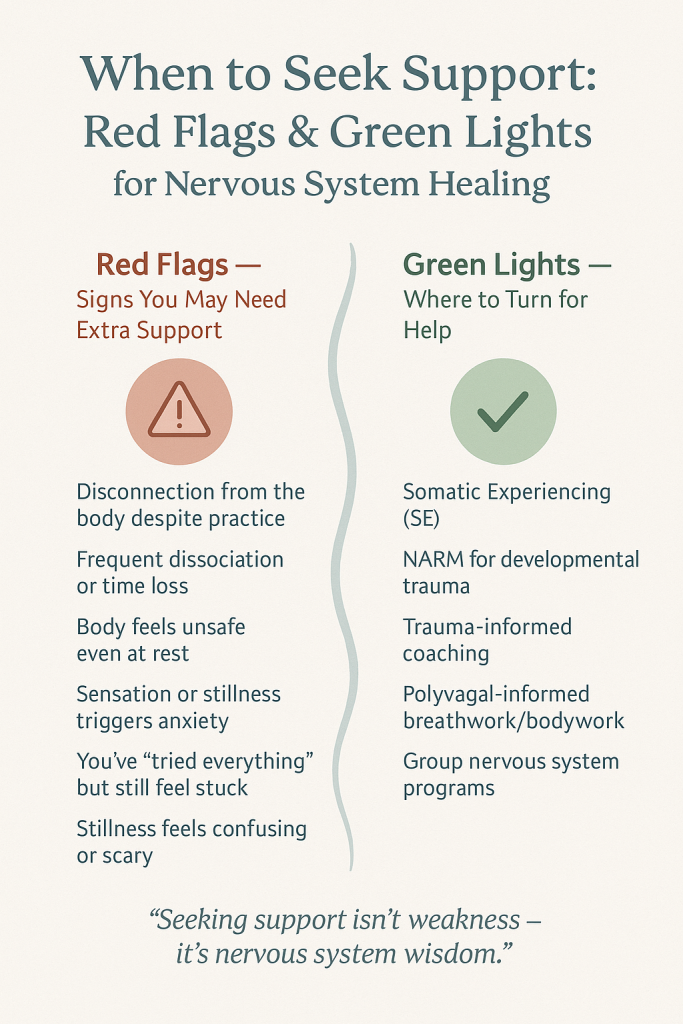
When to Seek Professional Support

Self-guided tools can help — but some patterns need a witness.

Consider working with someone if:

  • You feel disconnected from your body
  • You dissociate or lose time
  • Sensation or movement trigger fear
  • Tools don’t seem to help

Jason crashes on weekends despite high productivity.

“Even when nothing’s wrong, I feel like I’m short-circuiting.”

Rachel tenses during breathwork.

“I don’t feel safe relaxing. It’s like I’m waiting for the other shoe to drop.”

Eli understands the science — but can’t access feeling.

“I know what’s happening, but I can’t reach myself.”

Helpful support options:

  • Somatic Experiencing (SE) — body-based trauma work
  • NARM — for developmental trauma
  • Trauma-informed coaching
  • Breathwork and Polyvagal-informed bodywork
  • Nervous system-based group programs

“I want help as I come back online” is not weakness — it’s wisdom.

You Froze to Survive — Now You Can Reclaim Your Life

If you’ve felt blank, unreachable, or just off — your body wasn’t failing you. It was protecting you.

Freeze isn’t dysfunction. It’s survival.

And now, you get to choose something new.

Healing isn’t about erasing freeze. It’s about reconnecting — to your breath, to your body, to your life.

Jason pauses before the crash.
Rachel reclaims stillness.
Eli stays with sensation for one breath longer.

These aren’t breakthroughs. They’re returns — to the self that’s been waiting underneath.You are not broken.
You are not too late.
You froze to survive.
Now, you’re learning to come back — on your own terms.


Title Page Separator Site title

Slug

Meta descriptionUse AIInsert variable

SEO analysisEnter a focus keyphrase to calculate the SEO score

Premium SEO analysisPremiumAdd related keyphrasePremiumTrack SEO performanceInternal linking suggestionsPremium

Cornerstone content

Advanced

Insights

Use up and down arrow keys to resize the meta box panel.PostBlock

Paragraph

Start with the basic building block of all narrative.

Block Controls

Block stylesSelect a block styleBlue messageGreen messageOrange messageRed messageGrey messageLeft blockRight blockBlockquotes

This option let you add custom style for the current block

Attributes

All options are currently hidden

Advanced

Skip to the selected blockOpen publish panel

  • Post
  • Paragraph

Filed Under: Uncategorized

The Fawn Response: When Anxiety Disguises Itself as Kindness

May 3, 2025 by Dan Ma Leave a Comment

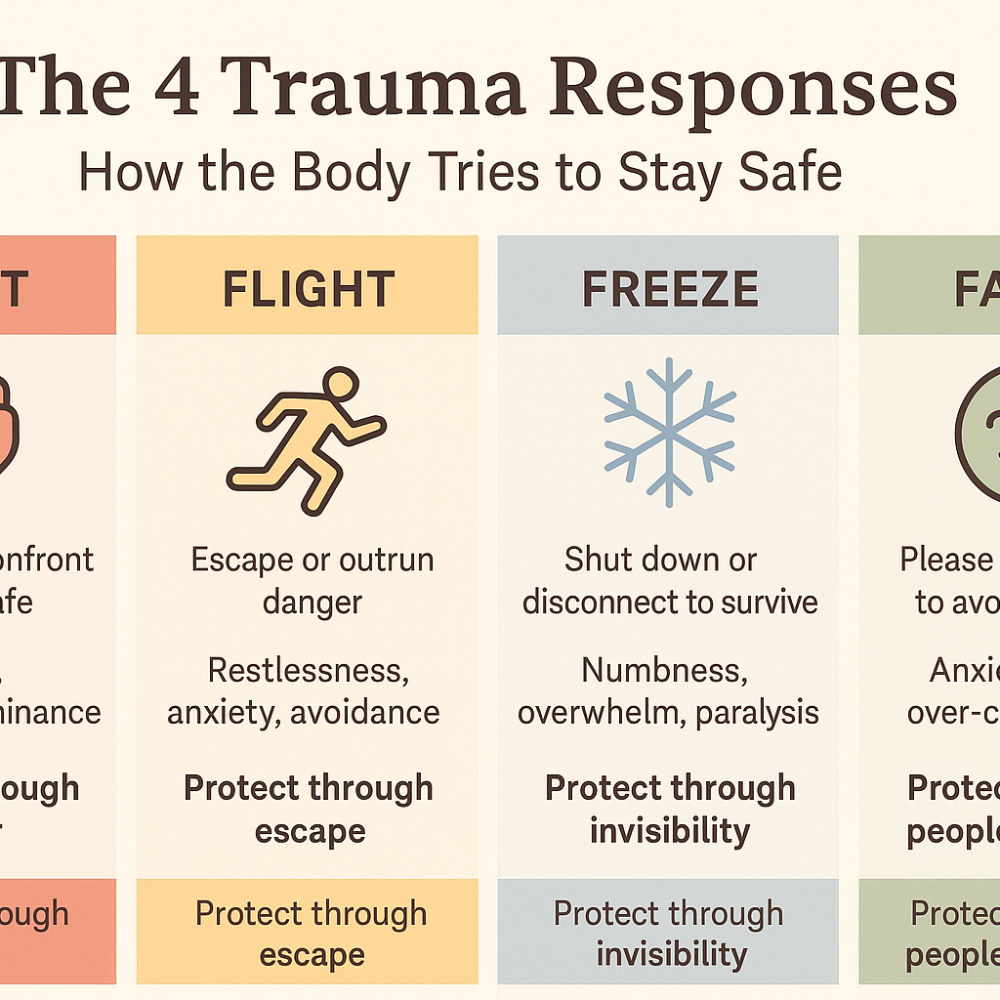
4 Trauma Responses

Understanding the Fawn Response as a Trauma-Based Survival Strategy

4 Trauma Responses

You always say yes. You make sure everyone’s comfortable. You avoid conflict like the plague. But underneath it all, you’re anxious, exhausted, and afraid of letting anyone down. That’s not just being “nice” — that may be the fawn response in action.

The fawn response is one of four trauma response types — alongside fight, flight, and freeze. These aren’t personality traits or choices. They’re automatic nervous system survival responses to perceived emotional danger.

Fawning is the least recognized of the four. It often hides in plain sight — as people-pleasing, conflict avoidance, or self-sacrifice. On the outside, it may look like empathy or emotional maturity. On the inside, it’s anxiety: a body trying to stay safe by keeping others happy.

This response is formed early — often in environments where love felt conditional or conflict meant emotional withdrawal. Over time, the nervous system learns: “If I appease, I’ll be okay.” It’s not a strategy of logic — it’s a pattern rooted in survival.

The fawn response is often misunderstood — it’s not about kindness; it’s about survival. And while it may have protected you once, it doesn’t have to define you now.

What Is the Fawn Response?

The fawn response is a trauma-based survival strategy where your body learns to maintain safety by prioritizing others’ comfort — often at the expense of your own needs, boundaries, and voice.

This is not about kindness. It’s about survival.

When the nervous system perceives emotional threat — like conflict, criticism, or abandonment — it may choose appeasement as the safest path. The fawning trauma response emerges as people-pleasing, conflict avoidance, self-erasure, and chronic agreeableness — all common signs of people pleasing and anxiety. Outwardly, it can look like emotional intelligence. Inwardly, it’s often anxiety and fear in disguise.

“The fawn response is the nervous system’s way of saying: ‘If I keep you calm and happy, I’ll stay safe.’”

Fawning is commonly mistaken for empathy or maturity — but it’s not the same. While empathy is rooted in self-awareness and mutual care, fawning is fear-based. It’s an unconscious pattern driven by a body trying to avoid harm, not connect freely.

At its core, this is a nervous system trauma response, often shaped by early experiences of unpredictability or emotional invalidation. It isn’t a decision — it’s a deeply embedded adaptation.

Recognizing this pattern is the first step toward reclaiming safety and self-trust. The fawn response may have helped you survive — but it doesn’t have to lead the way forever.

Why the Fawning Trauma Response Happens

Rooted in Trauma and Nervous System Dysregulation

The fawning trauma response develops in environments where emotional safety is unpredictable — not always through overt abuse, but often through subtle, chronic instability.

When a child is punished for expressing needs, made responsible for others’ feelings, or only shown love when they’re helpful or quiet, the nervous system adapts. It learns:
“If I soothe, serve, or silence myself — I’ll avoid pain.”

In these cases, fight or flight might not feel safe or possible. The body chooses a different strategy. The amygdala still detects threat, but instead of running or resisting, the nervous system opts for appeasement. Submission becomes the safest way to maintain connection.

This is a nervous system trauma response — not a choice or character flaw. The ventral vagal system, responsible for connection, can activate under fear — not just safety. What looks like helpfulness or calm may actually be the body trying to survive.

Fawning often becomes automatic. A person may not realize they’re doing it. Saying yes when they want to say no. Smiling when they feel afraid. Over-functioning in relationships. Softening truth, shrinking needs. It’s not deception — it’s the body protecting itself.

“This isn’t manipulation. It’s survival through self-erasure.”

This pattern is especially common in “nice” families that avoid conflict, in homes with emotional enmeshment — where boundaries between self and others are blurred — or in cultures where obedience and helpfulness are equated with worth. These dynamics often lead to people pleasing trauma — where care for others overrides care for self.

While trauma response types like fight or flight are often visible, fawning hides in plain sight. It’s often praised as maturity, when in fact, it’s a nervous system shaped by fear.

It’s a nervous system trauma response — not a decision, and not a flaw. And recognizing it is the first step to healing.

Signs of the Fawn Response

Internal and External Symptoms of Fawning

How to Spot the Fawn Response

The fawn response can show up in ways that are often mistaken for kindness, helpfulness, or maturity — but are rooted in anxiety and fear.

Fawning isn’t about being nice. It’s a survival strategy — one the nervous system develops to maintain emotional safety through appeasement.

“These signs aren’t just social habits — they’re how the body tries to stay safe through appeasement.”

To recognize it in yourself or someone else, look for these internal experiences and external behaviors:

🧠 Internal Symptoms:

  • Persistent guilt or anxiety after saying no
  • Fear of being disliked, rejected, or abandoned
  • Trouble identifying your own needs, preferences, or feelings
  • Feeling invisible, resentful, or emotionally overextended
  • Emotional numbness or dissociation after conflict or criticism

🧍 External Behaviors:

  • Over-apologizing — even for things beyond your control
  • Saying yes reflexively, even when overwhelmed
  • Avoiding disagreement, feedback, or criticism
  • Smiling or agreeing outwardly while feeling discomfort inside
  • Taking responsibility for others’ feelings or stress
  • Caretaking or “fixing” — especially when others haven’t asked for it — as your default mode in relationships

These symptoms of fawning trauma response can be hard to spot — especially because many are socially rewarded. Being helpful, agreeable, or emotionally attuned is often seen as strength. But when these behaviors are driven by fear or a need to avoid conflict, they may be signs of people pleasing and anxiety, not true connection.

“Do you ever feel more comfortable pleasing others than stating your own needs? Do you feel anxious when someone’s upset with you — even if you’ve done nothing wrong?”

These patterns don’t mean you’re weak. They mean your body learned to protect you by blending in, pleasing others, and minimizing your own presence. And while the fawn response may have helped you survive before, it’s not the only way to feel safe now.

Recognizing these signs is the first step. Healing begins with reconnecting to your needs — and your nervous system.

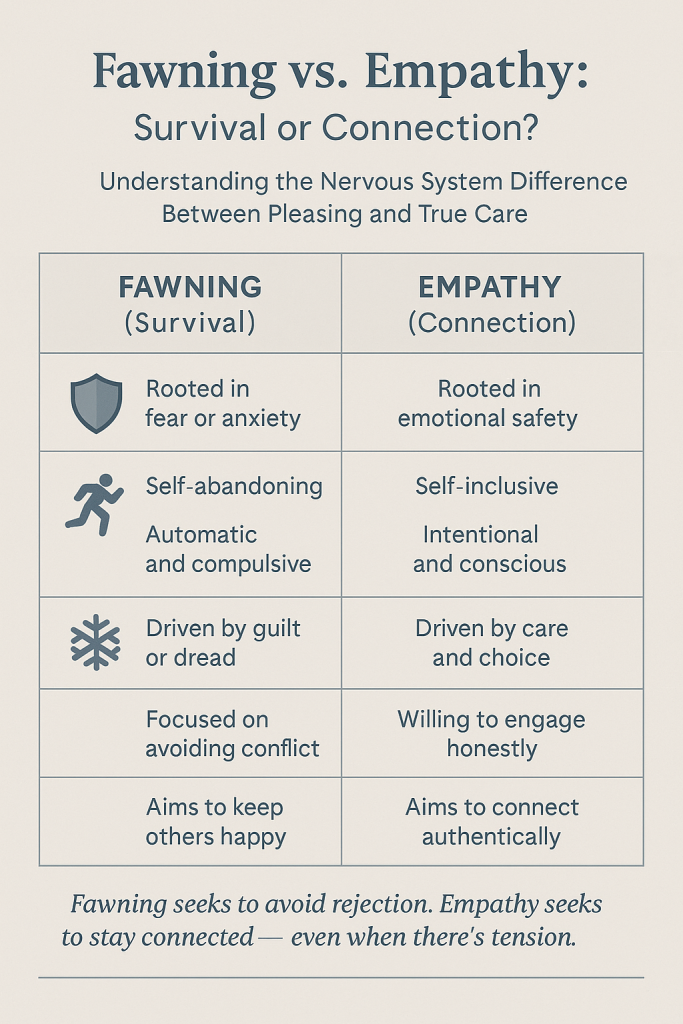
Fawning vs. Empathy: A Survival vs. Connection Table

Comparing Survival Behavior to Healthy Empathy

The fawning trauma response is not empathy — it’s a nervous system strategy for safety, not connection.

At first glance, fawning may look like kindness, compassion, or emotional intelligence. It’s often praised, encouraged, and rewarded — especially in environments where conflict is avoided and helpfulness is equated with worth. But underneath fawning is fear. The impulse isn’t to connect; it’s to prevent rejection, conflict, or abandonment.

By contrast, healthy empathy is rooted in safety, boundaries, and mutual care. It includes you, not just the other person. And it isn’t afraid of discomfort.

Here’s how to tell the difference:

“Fawning seeks to avoid rejection. Empathy seeks to stay connected — even when there’s tension.”

This confusion is common — especially among those who’ve spent years in people pleasing and anxiety patterns. Fawning often begins as a survival tactic in childhood, becoming a reflex over time. But empathy, in its truest form, requires boundaries, clarity, and courage. It includes the ability to say no, to speak truthfully, and to care without losing yourself in the process.

“The fawning trauma response is not empathy — it’s a trauma coping strategy, not a sign of emotional health.”

When you begin to recognize the difference, you can begin shifting from survival strategies to more grounded, connected ways of relating — rooted in safety, truth, and choice.

Why the Fawning Response Often Goes Unnoticed

Socially Rewarded but Nervously Driven

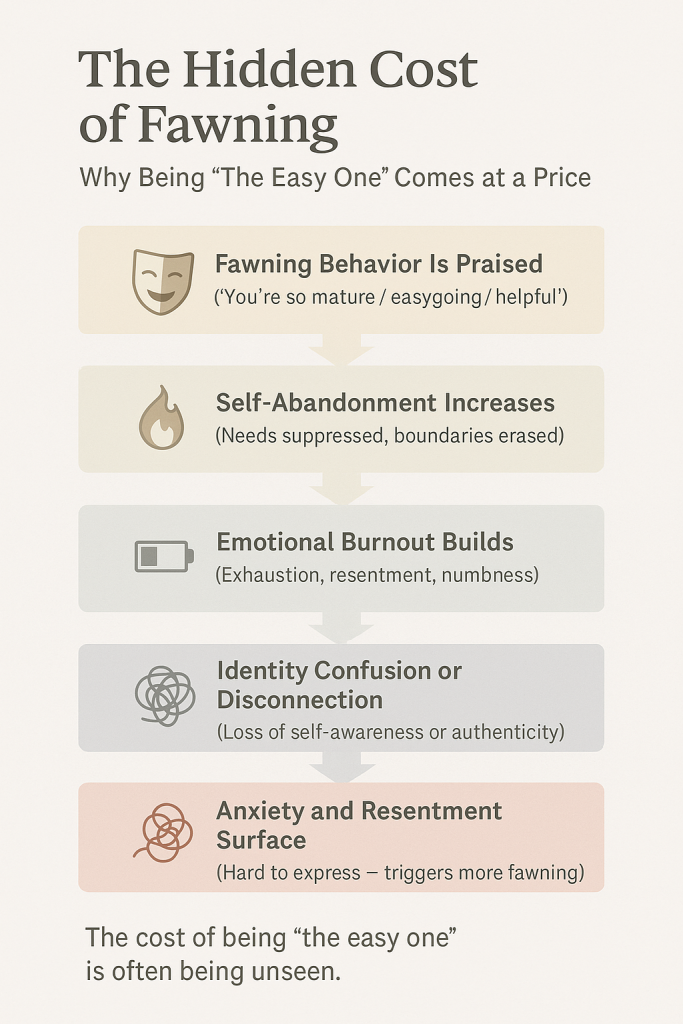
The Hidden Cost of Fawning

Fawning is often invisible — not because it’s subtle, but because it’s praised.

People with a fawning trauma response are frequently described as:

  • “So mature for their age”
  • “Easygoing”
  • “The peacemaker”
  • “The one everyone counts on”

These labels are socially rewarding — but they mask a deeper truth. The behavior they applaud isn’t always about calmness or care. It’s about survival.

“Fawning is often mistaken for emotional intelligence — when it’s actually emotional over-responsibility.”

Fawning looks like empathy, helpfulness, or emotional strength. But it’s driven by people pleasing and anxiety, not genuine connection. It’s a nervous system pattern — a nervous system trauma response — formed in environments where disagreement, needs, or emotional honesty felt unsafe.

Often, the person fawning doesn’t even realize they’re doing it. It’s automatic. A reflex. Say yes. Smile. Stay agreeable. Keep others happy, no matter the cost.

This unconscious habit is especially reinforced in environments like:

  • Families where children become emotional caregivers (parentified children)
  • Cultures that equate obedience with virtue
  • Workplaces where quiet compliance is seen as professionalism
  • Gender norms that celebrate self-sacrifice over self-expression

In these systems, people pleasing trauma becomes invisible — because it looks like success.

But under the surface, fawning takes a toll. It leads to emotional burnout, identity confusion, and chronic suppression of needs. It’s rarely questioned until resentment builds or exhaustion takes over.

The cost of being “the easy one” is often being unseen.

Recognizing the nervous system behind your people-pleasing is not about blame — it’s about reclaiming your right to take up space, set boundaries, and relate from safety instead of survival.

How to Heal from the Fawn Response

Somatic Tools to Rewire Your Survival Pattern

Tools for Healing the Fawn Response

Healing the fawn response isn’t about forcing change — it’s about helping your nervous system feel safe enough to choose differently.

This healing isn’t a mindset shift. It’s a body-first process. The fawn response is a nervous system adaptation — a survival pattern wired in response to emotional threat. You don’t “break” this pattern. You retrain it by creating felt experiences of safety, voice, and self-trust.

“You don’t think your way out of fawning — you feel your way to safety.”

These somatic healing tools aren’t quick fixes, but body-based practices that gently rewire your response to relational stress:

1. Breathwork for Regulation

Use long, slow exhales to activate your parasympathetic nervous system — the part of your body that signals “I’m safe now.”

Practice pausing to breathe when you feel the urge to appease, agree, or smooth things over. Breath becomes an interrupt signal. You teach your body: “I can pause. I can stay with myself. I don’t have to rush toward approval.”

2. Voice Practice for Boundaries

Start small by rehearsing simple phrases — even silently or privately:

  • “Let me think about that.”
  • “That doesn’t work for me right now.”
  • “I see it differently.”

These aren’t just scripts. They’re nervous system rehearsals that reverse trauma coping patterns like vocal suppression and emotional shrinking. As you speak, notice the sensations in your body — tension, release, fear, pride. All of it is data, not danger.

3. Micro-Boundaries as Safety Rehearsals

Boundaries don’t have to be big or dramatic. Try tiny, intentional acts that signal safety without submission:

  • Waiting before responding to a message
  • Saying “not today” to a small favor
  • Letting someone misunderstand you without fixing it

These moments help your body practice: “It’s okay to be misunderstood. It’s safe to be separate.”

“You’re not broken. You’re adapting.”

Fawning helped you survive when connection felt conditional. But now, your nervous system can learn something new:

“The same nervous system that helped you survive can now learn what it feels like to be safe — without self-abandonment.”

Go slow. One breath, one pause, one choice at a time. This is the path of healing the fawn response — not through force or willpower, but through embodied safety, breath by breath.

The Fawn Response Can Be Unlearned: You Are Not Broken

The fawn response helped you survive. But it doesn’t have to lead anymore.

What looks like people-pleasing or passivity is often a nervous system trauma response — a pattern your body learned to protect you in environments where safety, boundaries, or emotional honesty felt risky. That wasn’t weakness. That was wisdom.

And healing the fawn response isn’t about forcing yourself to be different. It’s about gently showing your body that safety, voice, and truth are possible now.

“You are not broken — you are adapting.”

Your nervous system — like all trauma response types — can learn. With breath, with pause, with practice, you can move from:

  • Hyper-attunement → self-inclusion
  • Pleasing → boundaries
  • Anxiety → regulation

“The same nervous system that helped you survive can now learn what it feels like to be safe — without self-abandonment.”

This isn’t about fixing yourself. It’s about coming home to yourself.

Ask gently:

  • Can I honor how this pattern protected me?
  • Can I begin to imagine a relationship where I don’t have to disappear?

Each moment of breath, each truth spoken kindly, each boundary held softly — they’re not just behaviors. They’re evidence that healing the fawn response is already in motion.

You are not starting from scratch. You’re starting from strength.

Filed Under: Uncategorized

The Anatomy of Hyper-Vigilance: Understanding the Hidden Patterns of Anxiety

April 28, 2025 by Dan Ma Leave a Comment

Hyper-vigilance is a heightened state of sensory sensitivity, marked by an intense readiness to detect threats. It is not simply anxiety or suspicion — it’s a survival-driven response shaped by the nervous system.

When someone has experienced trauma, chronic stress, or unsafe environments, their body learns to stay on high alert, even when immediate danger is absent. This state of over-anticipation is not about imaginary threats (as in paranoia), but about a finely tuned system responding to real, lived experiences. Hyper-vigilance scans for potential risks because, at some point, it had to.

Understanding hyper-vigilance through this lens is crucial. It is not a flaw, weakness, or mental illness. It is an intelligent, adaptive strategy: the body’s way of protecting itself when survival once depended on vigilance. Compassion, not judgment, is the key to seeing it clearly — and to helping those who live with it find a new way home to safety.

The Nervous System’s Role in Hyper-Vigilance

The autonomic nervous system is the body’s built-in survival command center. It automatically regulates functions like breathing, heart rate, and vigilance—keeping us alive without conscious effort. It operates through two main branches: the sympathetic nervous system, which activates us for survival action (“fight or flight”), and the parasympathetic nervous system, which supports recovery, calm, and healing (“rest and digest”).

Fight, Flight, Freeze: The Body’s Built-In Trauma Responses

When the body detects danger, it launches a fight-flight-freeze trauma response. In fight mode, we gear up to confront the threat. In flight mode, we attempt to escape. And if neither is possible, the body may enter freeze mode—shutting down energy to survive overwhelming conditions. These responses happen automatically, driven by the nervous system’s deep survival intelligence.

Sympathetic Activation and Chronic Hyper-Vigilance

Hyper-vigilance develops when the sympathetic system becomes stuck in hyper-activation. Even after the original danger has passed, the body remains partially on high alert—primed to react at the slightest sign of potential threat. This often shows up as scanning crowds for exits, startling easily at noises, clenching muscles unconsciously, or struggling to fully relax even in safe environments.

Trauma leaves an imprint not only in thoughts or emotions, but within the body’s operating systems themselves—a trauma imprint on the nervous system. These embodied memories keep the survival circuits running, even when conscious awareness says it’s safe.

Understanding hyper-vigilance as a nervous system trauma response—not a character flaw—reframes it with the compassion it deserves. It’s the body’s loyal, persistent attempt to protect life, long after the actual threat is gone.

The Three Axes of Hyper-Vigilance

Three Axes of Hyper-Vigilance

Hyper-vigilance isn’t a single pattern — it expresses itself differently depending on how the nervous system has adapted for survival. Recognizing these differences helps individuals and practitioners better understand what the body is trying to protect — and tailor healing accordingly. Across thousands of lived experiences, three key types of hyper-vigilance consistently emerge: Scope, Theme Sensitivity, and Mobility.

Scope: Narrow vs Broad Threat Detection

Scope describes how widely someone’s survival radar is scanning.
A narrow scope focuses hyper-vigilance tightly on one or very few areas — such as obsessing over political news or fearing betrayal in close relationships.
In contrast, a broad scope disperses vigilance across multiple life domains — constantly monitoring work stress, social dynamics, health risks, and global crises all at once.

Example:
Someone with narrow vigilance might compulsively check one person’s texts for signs of rejection, while someone with broad vigilance might scan every environment for potential sources of harm.

Theme Sensitivity: Emotional Survival Themes

Hyper-vigilance Emotional Survival Themes

Hyper-vigilance often clusters around certain emotional survival themes — the deep wounds where the body once learned danger lives.
Common survival themes include:

  • Safety: Fear of sudden physical harm.
  • Betrayal: Fear of trust being broken.
  • Injustice: Hyper-alertness to unfairness or violations.
  • Control: Fear of unpredictability or chaos.
  • Belonging: Fear of exclusion, abandonment, or rejection.

Example:
A person sensitive to betrayal may interpret a late email response as proof of disloyalty, even when no harm was intended.

Mobility: Fixed vs Osmotic Vigilance

Mobility reflects how rigid or fluid hyper-vigilant focus becomes over time.
Fixed vigilance locks onto a specific threat or issue — replaying it, obsessing over it, unable to shift attention.
Osmotic vigilance allows the focus to seep across multiple topics — flowing from concern about work layoffs, to sudden health anxieties, to fears about family relationships.

Example:
Someone with fixed vigilance might fixate entirely on political instability for months, while someone with osmotic vigilance might feel their survival fears “move” from money issues to health issues to social fears week by week.

The Five Core Survival Themes

Hyper-vigilance doesn’t scan randomly — it focuses around old emotional wounds, the places where survival once felt most at risk. These emotional survival patterns shape the lens through which the body stays alert, guiding what it monitors, anticipates, and fears.

Each survival theme reflects a different deep fear the nervous system has encoded, born from real experiences where safety, trust, fairness, control, or connection were threatened.

Safety: Fear of Physical Harm

At its root, hyper-vigilance around safety says, “I’m not physically safe.”
The body constantly checks for danger — loud noises, sudden movements, exit points.

Example:
Feeling heart-racing panic when a door slams, even if logically you know there’s no threat.

Betrayal: Fear of Broken Trust

Betrayal-focused hyper-vigilance whispers, “I can’t trust people to keep me safe emotionally or relationally.”
Small changes in others’ behavior — delays, tone shifts — feel like signs of abandonment or deception.

Example:
Feeling abandoned when a friend doesn’t immediately text back.

Injustice: Fear of Unfair Harm

Injustice-rooted hyper-vigilance carries the fear, “The world is unfair and I will be wrongly punished or harmed.”
The body locks onto perceived unfairness — societal corruption, workplace double standards, personal slights.

Example:
Feeling personally attacked when seeing corrupt political news stories.

Control: Fear of Unpredictability

Control-driven hyper-vigilance echoes, “If I don’t control everything, disaster will happen.”
Schedules, routines, and micromanagement become attempts to fend off chaos and reclaim safety.

Example:
Feeling a spike of panic if plans change unexpectedly.

Belonging: Fear of Rejection and Exclusion

At the heart of belonging hyper-vigilance is the survival fear, “If I show weakness, I’ll be excluded, abandoned, or exiled.”
The body scans social cues for acceptance or rejection, often over-interpreting small interactions.

Example:
Feeling deep shame after a minor social slip-up, convinced others now see you as weak.

Closing Tie-In: Recognizing these themes of trauma response is not about labeling ourselves — it’s about honoring what the body has been protecting all along.
Each emotional survival theme shows us exactly where trust, safety, and healing are still needed — and where the journey home begins.

Healing Hyper-Vigilance

Healing hyper-vigilance isn’t about telling the mind to calm down — it’s about gently showing the body that it no longer has to fight old battles.
The survival system doesn’t deactivate through force or logic.
It softens through new conditions of safety: real, tangible, embodied experiences that gradually retrain the nervous system’s alarms.

Understanding how to heal hyper-vigilance means focusing less on suppression and more on re-teaching the body what safety feels like.

Somatic Grounding: Reconnecting to the Present Moment

The first step is somatic healing for anxiety — reconnecting awareness to the body and to the now.
Grounding practices give the nervous system real-time evidence that it is here, not back in old danger.

Examples include:

  • Feeling the pressure of your feet on the ground.
  • Progressive muscle relaxation, slowly releasing tension one area at a time.
  • Visualizing heaviness, imagining the body gently sinking into the earth with each exhale.

These small anchors tether the mind and body together, interrupting the automatic drift into threat anticipation.

Repatterning Felt Safety: Building New Body Maps

True nervous system regulation for trauma isn’t about deep breaths and mantras alone.
It’s about accumulating micro-experiences of safety that the body can actually absorb.

Key practices include:

  • Mindful breathing — simply noticing the breath without forcing it to change.
  • Gentle, rhythmic movements like rocking, swaying, or slow walking.
  • Sensory soothing through weighted blankets, calming music, or soft textures.

Over time, these repeated safe experiences help the body update its internal maps — a process sometimes called gradual trust remapping.
Every moment of safety creates a new neural imprint: It’s okay now. You can be here.

Repairing Relational Trust: Healing Through Connection

Many survival patterns formed because connection once carried danger.
Healing hyper-vigilance often means learning, slowly, that some relationships can be safe, attuned, and nurturing.

Healing relational trust involves:

  • Setting boundaries and having them respected.
  • Being seen, heard, and accepted without judgment.
  • Experiencing healthy “rupture and repair” — small misattunements that are addressed and mended, not ignored or punished.

Trauma nervous system healing isn’t solitary work.
The body needs safe others to learn that connection doesn’t have to cost safety.

Final Reminder:
You don’t heal hyper-vigilance by commanding the mind to relax.
You heal it by gently teaching the body, again and again, that it is safe to stand down — not because it was wrong to be vigilant, but because the danger has finally passed.

Conclusion: Healing from Hyper-Vigilance

Hyper-vigilance is not a flaw, a weakness, or a madness.
It is the body’s brilliant, determined way of surviving what once felt unbearable.
Those who live with hyper-vigilance are not broken — they are survival experts, carrying the wisdom of every moment they endured.

But survival does not have to be the only mode of existence.
Through patient nervous system healing, gentle somatic grounding, and safe relational repair, it is possible to move beyond constant threat readiness.
It is possible to reclaim presence, to feel the breath in the chest, the ground underfoot, the soft safety of connection.

Healing from hyper-vigilance is not about forgetting what happened.
It is about teaching the body, one moment at a time, that it is safe to be here now. Every tremor of hyper-vigilance points not to brokenness — but to a map.
A map showing exactly where healing is most needed.
And with the right care, that map can lead home.

Filed Under: Uncategorized

Exploring Subtle Bodies: How Energy Layers Shape Your Life

December 3, 2024 by Dan Ma Leave a Comment

Have you ever wondered why some days feel energetically “off,” while others flow seamlessly? The answer might lie in your subtle bodies—invisible layers of energy that influence your emotions, thoughts, and even physical well-being. These energetic layers aren’t just abstract ideas; they’re an integral part of how we experience balance, resilience, and connection in everyday life.

Understanding your subtle bodies can unlock practical benefits, from reducing stress to enhancing mental clarity and emotional stability. Imagine gaining insight into your personal energy, discovering how it shapes your interactions, and learning how to harmonize it for greater vitality and peace.

Whether you’re curious about subtle bodies or already exploring practices like meditation, energy healing, or yoga, this guide will illuminate their significance. Together, we’ll uncover what subtle bodies are, how they shape your life, and why understanding them is essential for personal growth and balance. For a more in-depth exploration, visit our Wellness Program to discover practical tools for aligning your energy layers.

What Are Subtle Bodies?

Core Definition

As a trainer, self-improvement begins with the physical body—the foundation of our daily experiences. However, beyond the physical lies a complex network of subtle bodies—layers of energy that influence your emotions, thoughts, and spiritual well-being.

These energetic layers work in harmony with the 7 chakras, the body’s energy centers, which regulate the flow of energy through different aspects of your being. For instance, the etheric body serves as the energetic blueprint of your physical self, while the astral body is the seat of your emotions. By understanding and balancing these layers, you can unlock deeper levels of health and harmony.

Understanding the Layers of Subtle Bodies

Subtle bodies are often categorized into distinct layers, each serving a specific role in our holistic well-being. These layers extend beyond the physical body, influencing our energy, emotions, and spiritual growth.

  1. Physical Body: The tangible foundation of self-improvement, supported by practices like strength training and corrective exercises.
  2. Etheric Body: The energetic blueprint of the physical body, which can be nurtured through grounding techniques, breathwork, and Qigong.
  3. Astral Body: The seat of emotions, harmonized through practices like mindfulness, emotional release techniques, and journaling.
  4. Mental Body: Governs thought and perception, improved through meditation, visualization, and focus-building exercises.
  5. Spirit Body: The connection to higher consciousness and spiritual awareness, accessed through deep meditative states and practices like shadow work or energy alignment.

Each of these layers interconnects with the 7 chakras and the broader energy system. By addressing them through targeted modalities, you can bring balance and vitality to all aspects of your being.

Why Do Subtle Bodies Matter?

Real-Life Relevance

Subtle bodies are more than just abstract concepts—they have a tangible influence on your daily experiences. For instance, unresolved stress from work can disrupt energy flow in your astral body, creating emotional tension and even physical fatigue. Over time, this imbalance may drain vitality, making it harder to focus and maintain energy throughout the day.

By addressing these energy layers, you can promote emotional resilience and restore vitality. For example:

  • Recharging your etheric body through grounding practices like Qigong can help stabilize your physical energy.
  • Processing emotional blocks in the astral body with mindfulness or journaling allows you to release tension and regain clarity.

When these energetic systems are balanced, they act as a foundation for emotional and physical harmony, enabling you to navigate life with ease.

Addressing Common Challenges

Many everyday challenges—such as chronic stress, emotional fatigue, or a sense of disconnection—are tied to imbalances in the subtle bodies. These energy blockages can leave you feeling stuck, drained, or out of sync with yourself.

  • Chronic Stress: Practices like visualization or mindful breathing can align the mental body, helping you clear mental clutter and cultivate focus.
  • Emotional Fatigue: Energy-clearing rituals and emotional awareness exercises support the astral body, alleviating feelings of overwhelm.
  • Feeling Disconnected: Journaling or chakra-focused meditations can strengthen your connection to the spirit body, fostering a sense of purpose and alignment.

Understanding how chakras influence emotional awareness can deepen your connection to these practices and enhance energy flow for greater balance.

Practical Science and Everyday Benefits

In the area of energy work, there is a lot of science and benefits that go into understanding how subtle bodies influence well-being. Modern research in fields like energy medicine and quantum biology suggests that the biofield, or the electromagnetic field surrounding the body, plays a significant role in regulating physical, mental, and emotional states.

Balancing subtle bodies can have a measurable impact on everyday life. For instance:

  • Stress Relief: Aligning the mental body through practices like meditation helps calm the mind and lower cortisol levels.
  • Improved Focus: Recharging the etheric body through grounding exercises stabilizes energy, creating a foundation for mental clarity.
  • Enhanced Physical Health: Harmonizing energy flow across all layers can support better sleep, stronger immunity, and increased vitality.

By connecting ancient wisdom with emerging scientific understanding, subtle body awareness offers a practical framework for enhancing well-being. Whether you find metaphysical framing fascinating or prefer a practical approach to well-being, modern holistic health and ancient wisdom regarding holistic health both aim for the same thing. Balancing different aspects of yourself is a powerful way to promote both emotional resilience and physical vitality.

How to Begin Exploring Subtle Bodies

I’ve seen for many, the journey into subtle body awareness begins with the physical body—the most accessible and tangible layer. In a world that often pulls us toward external distractions, reconnecting with your body through movement and skill-building exercises lays the groundwork for exploring your energetic, emotional, mental, and spiritual layers.

Skill-based exercises not only build physical confidence but also foster bodily awareness, helping you become more present and attuned to the signals your body sends. From there, you can begin working with the other subtle bodies.

Beginner-Friendly Practices

  1. Skill-Based Exercise: Skill-based exercises like resistance training, martial arts, or yoga help improve bodily awareness and build confidence. These practices activate the physical body and create a strong foundation for connecting with your energetic and emotional layers.
  2. Restorative Practices: Gentle stretches, foam rolling, or practices like restorative yoga help release tension stored in the physical body while calming the mind and opening pathways to the etheric body.
  3. Qigong and Yoga: These movement-based practices stimulate energy flow, preparing the body for life force energy flow while promoting balance across all subtle layers. They are particularly effective for grounding and clearing stagnant energy.
  4. Chakra Work: I recommend working with the sacral chakra first rather than the root chakra, because modernity often has us sitting on our root, compounding the challenge of accessing a chakra already burdened with past traumas dealing with stability and survival. First, locate your sacral point—just underneath your navel, about an inch or so. Spend time breathing in and out of this point, imagining a warm orange energy radiating there. Progressions in experiencing energy often begin with warmth or gentle sensations in the area.

Intermediate Practices

Life is often a progression you build off of, just like any relationship you’ve collaborated in, and the same is true for your relationship with your subtle bodies. The most intimate relationship you’ll ever have is the one with yourself, and how far you can progress is a measure of how much you can love. With greater self-awareness comes the ability to move toward endless progress, discovering deeper dimensions of your being.

Once you’ve established a strong foundation through beginner-friendly practices, you may be ready to explore techniques that deepen your connection to your subtle bodies. These methods are ideal for individuals who have already developed awareness through physical practices and mindfulness:

  1. Advanced Chakra Work: Techniques like advanced Qigong, such as moving the microcosmic orbit, are powerful tools for refining energy flow and harmonizing your energetic body. These practices involve strengthening your focus and require a body that is energetically prepared to consciously guide life force energy through the front and back pathways, promoting balance and vitality.
  2. Shadow Work: This practice involves exploring the emotional patterns and beliefs stored in your astral body, often tied to unprocessed experiences. While transformative, shadow work can be challenging when practiced alone, as it requires confronting your egoic nature. Seeking support through coaching or therapy can provide valuable guidance and help you navigate the process safely.

Readiness Checklist

Not sure if you’re ready for intermediate practices? Here’s a quick guide to help you decide:

  • ✅ You’ve developed a regular practice of meditation or mindfulness.
  • ✅ You’re comfortable reflecting on your emotional and energetic states.
  • ✅ You’re noticing stronger states of emotional intelligence.
  • ✅ You feel curious and open to exploring deeper layers of self-awareness.

If these resonate with you, try incorporating advanced Qigong or shadow work into your routine to discover new dimensions of your subtle energy system.

Conclusion and Next Steps

Exploring your subtle bodies is a journey toward harmonizing your mind, body, and spirit. As children, we see the world through a lens of wonder, where the unknown sparks excitement and everything feels limitless. As we grow, the quest for knowledge sharpens our perception, bringing clarity but often dimming the sense of magic we once knew.

The subtle bodies provide another way to view health and self-improvement. By starting with the physical body and progressing to deeper layers like the energetic, emotional, mental, and spiritual aspects, you can achieve a profound connection to yourself. This relationship lays the foundation for resilience, vitality, and endless personal growth.

Transform your energy, unlock your potential, and rediscover the magic within.

Transform & Rediscover

With personalized tools and expert guidance, you’ll uncover the transformative power of your subtle bodies and learn how to nurture them effectively. Reconnect with the awe, mystery, and limitless potential within.

Start your journey today

Filed Under: Uncategorized

Next Page »
  • Somatic Performance
  • Wellness Coaching
  • About
  • Blog
  • Contact

ReGroove Fitness | Somatic Personal Training in Portland, OR


Loading Comments...